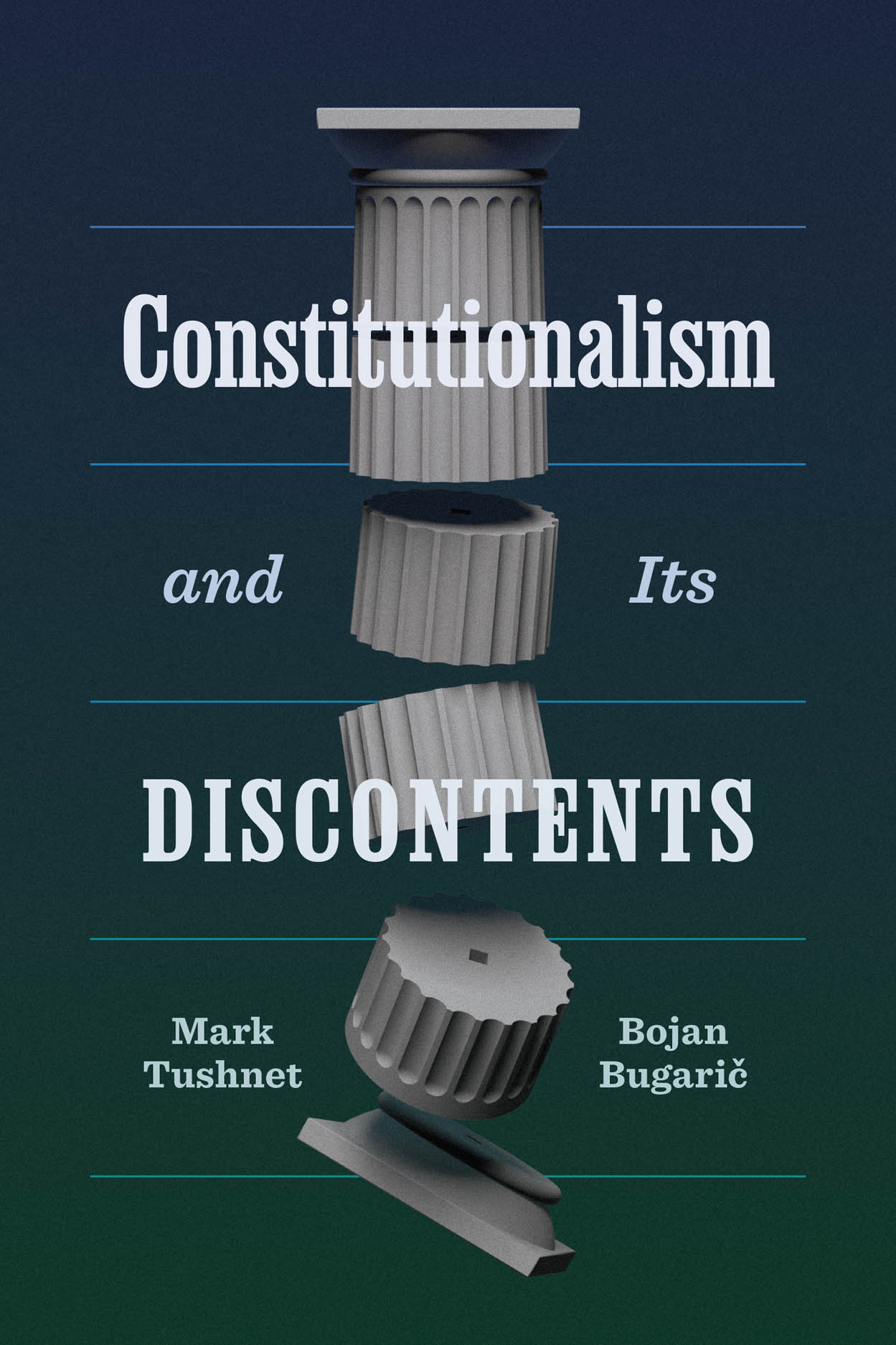
Constitutionalism and Its Discontents
Constitutionalism and Its Discontents
A thoughtful and provocative meditation on both the potential and limits of constitutionalism.
In the early twenty-first century, constitutionalism confronts numerous pressures and critiques. Some prominent critics are concerned that constitutionalism’s modern form, in which high courts play a large role, limits popular self-governance. By committing their nations to detailed social and economic policies—from neoliberal requirements for balanced budgets to constitutionalized social welfare and environmental rights—many modern constitutions might make promises they cannot keep and be unduly rigid in the face of changing social, economic, and environmental conditions. Meanwhile, the rise of proto-authoritarian elected leaders around the world shows that constitutions are vulnerable to, and may even enable, democratic backsliding.
Mark Tushnet and Bojan Bugarič argue that addressing each of these serious concerns through constitutional design and innovation is potentially valuable, but paradoxically, every remedy also carries with it the possibility that it will intensify the very conditions it seeks to ameliorate. Instead, Tushnet and Bugarič propose a “thin” idea of constitutionalism and suggest that we should scale back our expectations for what constitutionalism can achieve. Political mobilization, led by people attuned to the economic and cultural causes of democratic backsliding, is a better bet.
224 pages | 1 tables | 6 x 9 | © 2026
Law and Legal Studies: The Constitution and the Courts
Political Science: Comparative Politics
Reviews

Table of Contents
Introduction
Part I. Discontents with Constitutionalism
Chapter 1. Framing the Problem
Chapter 2. Democracy Without Rules
Chapter 3. How Limiting Power in the Name of Liberty Can Expand Power
Chapter 4. Constitutions as Conversations Among Equals
Part II. Discontents with Programmatic Constitutionalism
Chapter 5. The European Union’s Economic Constitution
Chapter 6. Reconstructing the European Economic Constitution
Part III. Discontents with Democratic Decline
Chapter 7. Framing the Problem Again
Chapter 8. Until We Outnumber Them: Opposing Autocrats in Power
Chapter 9. The False Promise of Constitutional Design
Chapter 10. Preventing Democratic Decline: The Role of Political Parties
Acknowledgments
Notes
Index