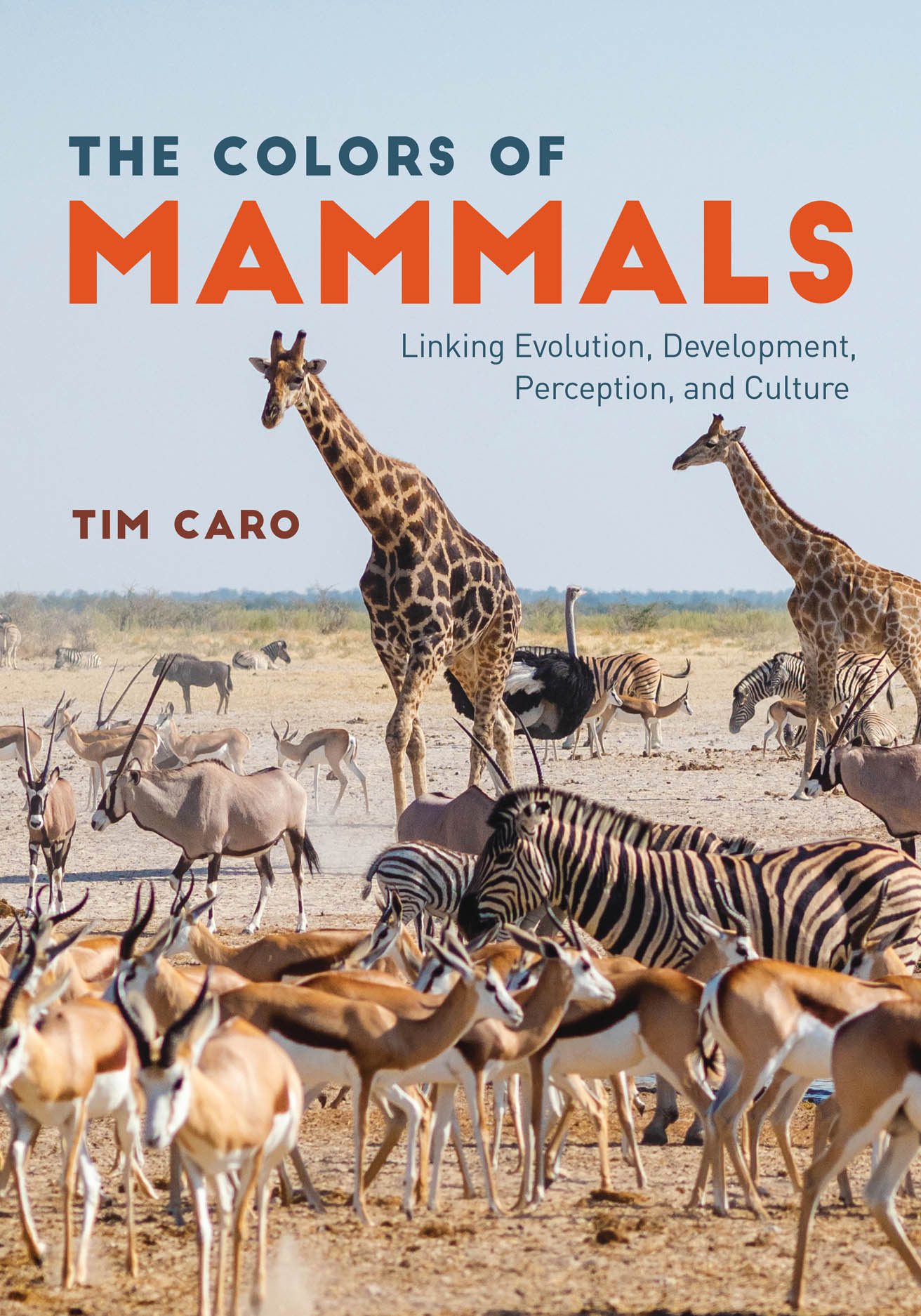
The Colors of Mammals
Linking Evolution, Development, Perception, and Culture
The Colors of Mammals
Linking Evolution, Development, Perception, and Culture
A principal coloration scientist offers a comprehensive and beautifully illustrated synthesis of coloration in mammals, weaving together contemporary research on evolution, underlying genetics, visual systems, and relevance to humans.
Why are giant pandas black and white, mandrills red and blue, but mice brown? How do mammalian colors and patterns develop? And why do we see in three colors, but deer do not? A cadre of evolutionary scientists, including geneticists, behavioral ecologists, visual ecologists, and anthropologists has worked for over a century to answer these and other questions about the origin and functions of mammal coloration in nature. One of them is celebrated biologist Tim Caro, who has studied animal coloration for over three decades. In this landmark book, he presents a synthesis of experimental and observational studies to explain how and why animal coloration has evolved for three primary reasons: protection against predators, communication, and to respond to environmental factors. Furthermore, Caro provides accessible descriptions of the various genetic and visual mechanisms that have shaped mammals’ extraordinarily diverse colors and patterns.
Victorian naturalists were the first to recognize that coloration influences individuals’ survival and reproduction, and this led to an explosion of research on its adaptive significance a century later. Then, at the beginning of the twentieth century, biologists began to work on the genomic and developmental basis of coloration. Since then, genetic studies on model organisms, particularly mice, have led to a deep understanding of the genes regulating the production of melanin pigments and lately, pattern formation. Simultaneously, scientists have studied organisms’ color perception. However, these functional, molecular, and mechanistic approaches rarely overlap, as they historically emanate from different areas of science. In this book, Caro ties these areas of research together for the first time. Caro outlines perception and production of color; teases apart different aspects of protective coloration; discusses social and sexual signaling; explores environmental drivers of coloration in nonhuman mammals, including domesticated species; and discusses human biology and our use of color in clothing. The resulting volume offers readers both a holistic view of today’s science and an honest assessment of the remaining questions for future research.
552 pages | 139 color plates, 4 halftones, 26 line drawings, 52 tables | 7 x 10 | © 2026
Biological Sciences: Behavioral Biology, Biology--Systematics, Evolutionary Biology
Reviews

Table of Contents
Preface
Why a Book on Mammal Coloration?
My Journey
Acknowledgments
1. Mammal Coloration: A Quick Guide
Historical Context
Why Are Extant Mammals Drab?
Function in a Nutshell
Development in a Nutshell
Pigment Regulation
Pigment Patterning
Introgression
Perception
Homo sapiens
Goals
Unresolved Issues
Synopsis
2. Color Perception
Color
History
Spectral Sensitivities
Distribution of Cells in the Retina
Why Has Color Vision Evolved?
Visual Acuity
Vision in Mammals
Monotremes and Marsupials
Eutherians
UV Sensitivity
Primate Vision
Catarrhines
Platyrrhines
Strepsirrhines
Evolutionary Drivers of Primate Color Vision
Benefits of Trichromacy
Detection of Ripe Fruit
Detection of Young Leaves
Social Information
Color Vision Polymorphism
Insect Foraging
Predation
Heterozygote Advantage
Unresolved Issues
Synopsis
3. Color Production
External Coloration
Melanin Synthesis
The Structure of Hair
Hair Growth
Molting
Melanogenesis
Genetics of Coat Color
Anomalies in Melanogenesis
Albinism
Leucism
Piebaldism
Melanism
Pattern Formation
Carotenoids
Blood
Structural Coloration
Fluorescence
Cosmetics in Nonhuman Mammals
Unresolved Issues
Synopsis
4. Background Matching
Ideas About General Resemblance
Early Empirical Studies of Mammalian Coloration
Phenotype-Environment Matching: Intraspecific Comparisons
Phenotype-Environment Matching: Interspecific Comparisons
Generalist or Specialist Background Matching
Genetics of Coloration in Mammalian Background Matching
Single Gene Mutations
Multiple Mutations at Same Gene
Transposable Elements
Pattern Formation in Mammalian Protective Coloration
Unresolved Issues
Synopsis
5. Color Change
Different Types of Color Change
Historical Background
Seasonal Changes
Adaptive Significance
Intrapopulation Variation
Interpopulation Variation
Thermoregulation
Melanogenesis
Introgression
Physiology
Climate Change
Age Changes
Natal Coats for Protective Coloration
Other Functions
Canities
Melanocyte Aging
Unresolved Issues
Synopsis
6. Self-Shadow Concealment and Other Forms of Crypsis
Camouflage
Self-Shadow Concealment
Eco-Correlates of Countershading
Ruminants
Primates
Marine Mammals
Small Mammals
Disruptive Coloration
Masquerade
Antiparasitic Coloration
Mechanism
Morphogenesis
Morphogenesis in Pattern Formation
Unresolved Issues
Synopsis
7. Color Variation
Color Polymorphisms
Felids
Canids
Ursids
Mephitids
Sciurids
Other Rodents
Cetaceans
Other Species
Color Variants
Examples of Rare Color Variants
Evolutionary Consequences
Unresolved Issues
Synopsis
8. Warning Coloration and Other Antipredator Strategies
Advertising Defenses
Aposematism
Carnivores
Rodents
Other Species
Venom with No Signal
Putative Cases of Aposematism
Mimicry
Flash Coloration
Pursuit Deterrence
Artiodactyls
Other Species
Deflection
Thanatosis
Unresolved Issues
Synopsis
9. Social Communication
Typical Colors
Species Recognition
Individual Quality
Individual Recognition
The Signal and the Message
Natal Coats in Primates
Sclerae
Unresolved Issues
Synopsis
10. Sexual Signaling
Historical Background
Ornamentation in Mammals
Where Is Sexual Dichromatism Found in Mammals?
Ornamentation in Nonprimate Mammals
Ornamentation in Male Primates
Brown Lemurs
Vervet Monkeys
Mandrills
Drills
Geladas
Snub-Nosed Monkeys
Rhesus Macaques
Pig-Tailed Macaques
Summary of Ornamentation in Male Primates
Ornamentation in Female Primates
Graded-Signal Hypothesis
Differentiating Between Cycles
Reliable-Indicator Hypothesis
Coloration
Facial Coloration
Other Concerns
Unresolved Issues
Synopsis
11. Homeostasis
Background
Coloration and Heat Load
Coloration Is Too Simplistic
Wind
Hair Depression
Coat Structure
Structural Properties of Hair Shafts
Molt
Coat Patterning
Skin Color
Skin Thickness
Behavioral Adjustments
Bogert’s Rule
Gloger’s Rule
The Rule in Mammals
Why Is Gloger’s Rule So Perplexing?
Glare
Coloration and Abrasion
Dark Coloration Maintained Because Alternatives Have Adverse Pleiotropic Effects
Unresolved Issues
Synopsis
12. Artificial Selection
Domestication
Origins of Coloration in Domestic Mammals
Horses
Pigs
Sheep
Cattle
Dogs
Cats
Gene Homologies in Domestic Mammals
Coloration and Pleiotropy
Unresolved Issues
Synopsis
13. Human Coloration
Color Variation
The Functions of Human Skin Coloration
Distribution of Skin Coloration Globally
Other Explanations
Hair and Eyes
The Genetics of Human Skin Coloration
MC1R and ASIP
HERC2 and OCA2
TYR, TYRP1, and DCT
SLC24A5
SLC45A2 and IRF4
Other Genes
Hair and Eyes Genetics
Social Meaning
Colorism
Sexual Selection
Pervasive Consequences of Colorism
Unresolved Issues
Synopsis
14. Protective Coloration in Military Defense
The Conventional Framework
Terminology
Background Matching
Uniforms
Equipment
Countershading
Dazzle
Deception
Disguise
Masquerade
Batesian Mimicry
Lures
Decoys
Reconciling Military and Animal Defenses
Unresolved Issues
Synopsis
15. Human Color Change
Types of Color Change
Physiological Changes
Cyclical Changes in Women
Health and Attraction
Blushing
Behavioral Changes
Fabric
Flags as a Mark of Group Identity
Clothing as a Mark of Group Identity
Effects of Women’s Clothing Color on Men
Effects of Men’s Clothing Color on Women
Cosmetics
Facial Contrast
Lipstick
Other Practices
Coloration in Competitive Sports
Effect on the Wearer
Effect on the Viewer
Effect on the Referee
Unresolved Issues
Synopsis
16. Thirteen Evolutionary Questions
1. What Is the Origin of Drab Coloration in Mammals?
2. What Is the Functional Significance of Patterning in a Model System?
3. Are Rodents Countershaded?
4. Why Are Primates So Colorful?
5. How Can We Explain Ontogenetic Color Change?
6. What Is the Extent of Disruptive Coloration in Mammals?
7. Do Mammals Use Color Patches for Social Communication?
8. How Does Phenotypic Convergence Arise?
9. Are Humans Obeying Gloger’s Rule for Different Reasons?
10. What Are the Exceptions to Gloger’s Rule?
11. Do People Actually Look More Attractive in Red?
12. Why Does the Military Eschew Biology?
13. Are Domesticated Mammals Still Subject to Natural Selection?
Caveat
Book Synopsis
References
Species Index
Subject Index