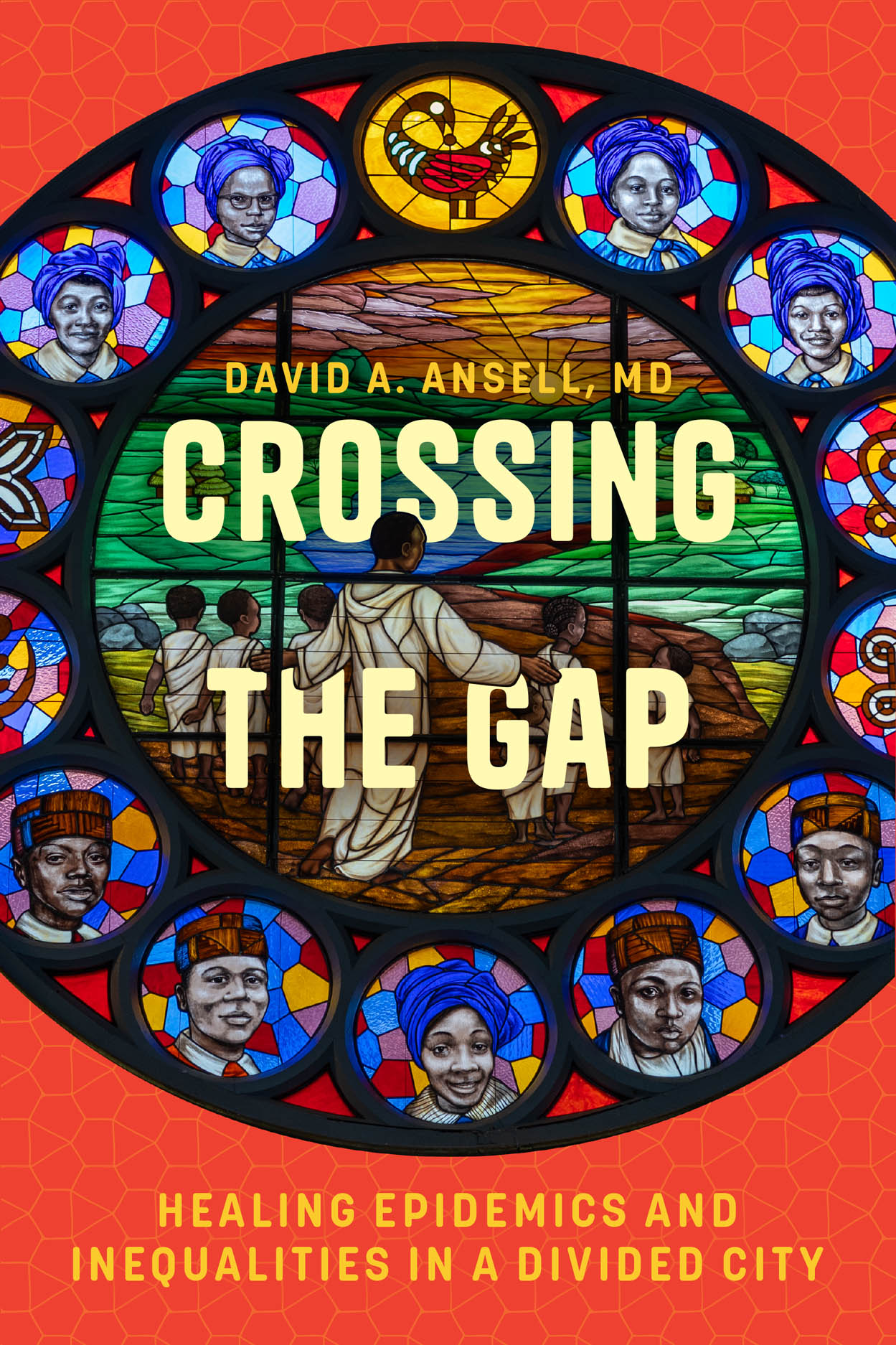
Crossing the Gap
Healing Epidemics and Inequalities in a Divided City
Crossing the Gap
Healing Epidemics and Inequalities in a Divided City
Publication supported by the Meijer Foundation Fund
A doctor, a disinvested neighborhood, and a radical experiment to close America’s death gap.
Two girls are born in the same Chicago hospital. Their neighborhoods—just seven train stops apart—will shape their futures and help determine how long they live. One will celebrate her eighty-fifth birthday. The other will die before sixty-five.
This is the death gap: lives lost too soon. Crossing the Gap asks how a city with world-class hospitals can tolerate an epidemic of premature death—and tells the story of the people fighting to end it.
In his landmark book The Death Gap, physician and health equity leader David A. Ansell exposed how structural racism and poverty shorten lives. He moves beyond diagnosis in Crossing the Gap to explore what happens when a major medical center joins forces with pastors, community organizers, residents, and young leaders on Chicago’s West Side to redefine what a hospital owes its neighbors. Part medical memoir and part urban chronicle, Crossing the Gap follows groundbreaking initiatives such as West Side United and the Sankofa Wellness Village as they confront decades of disinvestment and work to build healthier communities.
Through stories of collaboration, courage, conflict, and community leadership, Ansell shows how neighborhood voices, rigorous data, and moral imagination can transform health systems from bystanders into partners for change—not just in one city but throughout the nation.
Reviews

Table of Contents
1. A Tale of Two Cities
2. The Last Shall Be First
3. Anatomy of a Neighborhood’s Decline
4. I Want to Be like Steve
5. Paradigm Shift
6. March 1, 2020: Colliding Epidemics
7. We Were Built for This
8. Project Hope
9. One Million Deaths: Reflections on a National Failure
10. The Wounded Healer
11. The Still Small Voice
12. The Language of the Unheard
13. We Don’t Want Nobody Nobody Sent
14. Who Gets the Chance to Be Healthy?
15. Conclusion: A Good Omen
Acknowledgments
Notes
Index