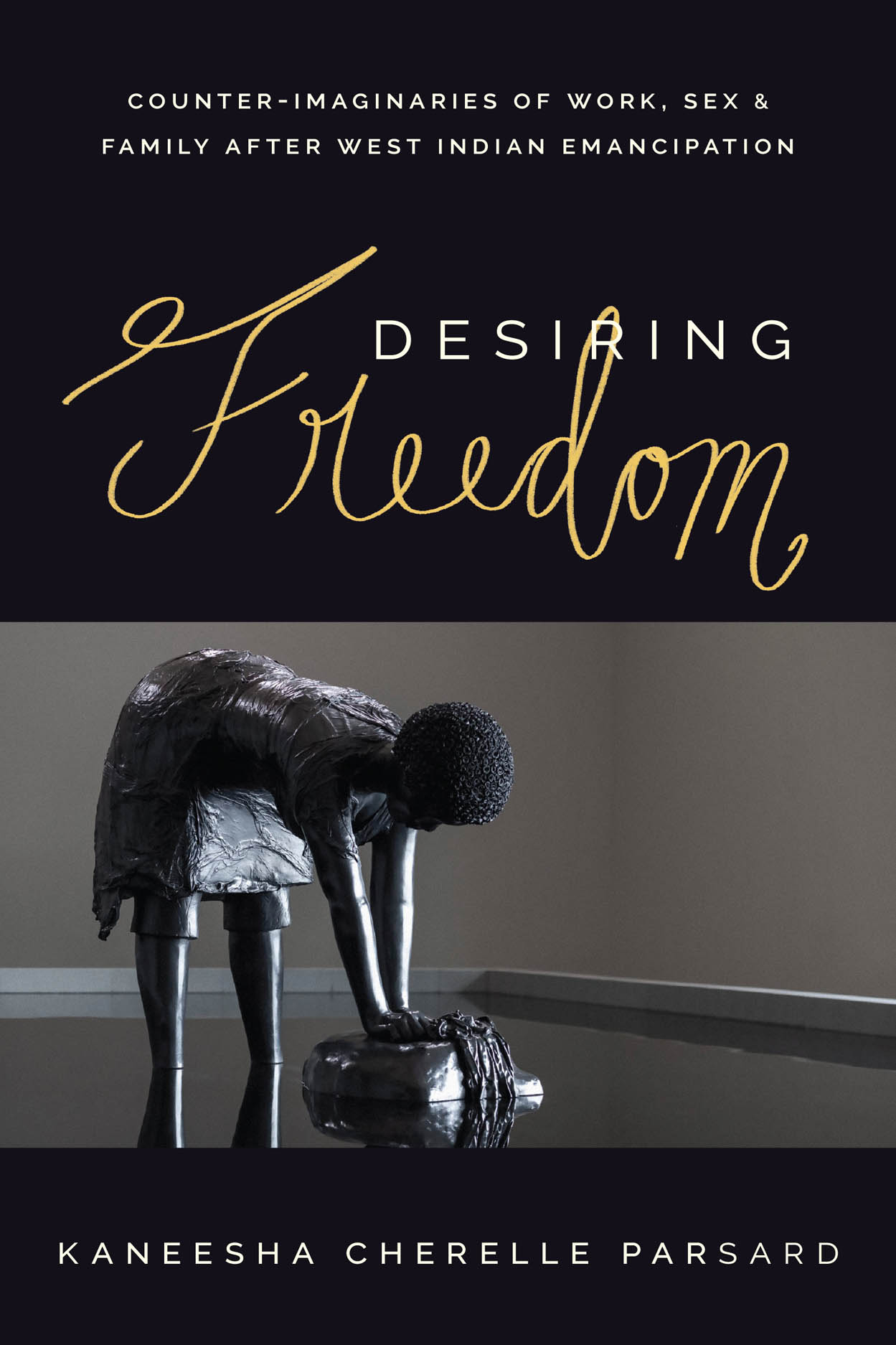
Desiring Freedom
Counter-Imaginaries of Work, Sex, and Family After West Indian Emancipation
Desiring Freedom
Counter-Imaginaries of Work, Sex, and Family After West Indian Emancipation
A groundbreaking account of concepts of freedom in West Indian literature and visual culture.
Desiring Freedom examines post-emancipation West Indian literature and visual culture to ask how they reimagine freedom. Ranging from emancipation in the 1830s to the arrival of independence in the 1960s, Kaneesha Cherelle Parsard analyzes a literary and visual repertoire through which West Indians and Britons cast doubt on wage labor and domesticity as freedom. Whereas freedom was traditionally conceived around narratives of the self-governing individual, Parsard unearths a diverse range of materials—fiction, poetry, painting, photography, imperial correspondence, social scientific discourse, and economic history—in which this plot breaks down, finding practices of freedom in hoarding, pleasure-seeking, hustling, and siphoning.
Parsard focuses on conceptions of freedom in Trinidad, British Guiana, and Jamaica. Along the way, she shows how indentured Indian women’s jewelry reveals contradictions in imperial capital, studies the short fiction of a 1930s Trinidadian literary collective called the Beacon group to reveal how women find both profit and pleasure in their affairs, and offers a fascinating reading of C. L. R. James’s only novel, Minty Alley—including a little-known alternative ending. In a key methodological contribution, Parsard develops proposition as a critical tool, drawing on its many valences—a sexual advance, a contract before its signing, and, in philosophy, the act of saying “this is how things stand.” Parsard’s own propositions show that West Indian culture offers new ways of seeing the relationships among race, labor, capital, gender, and sexuality after emancipation.
256 pages | 20 halftones | 6 x 9 | © 2026
Literature and Literary Criticism: British and Irish Literature, General Criticism and Critical Theory
