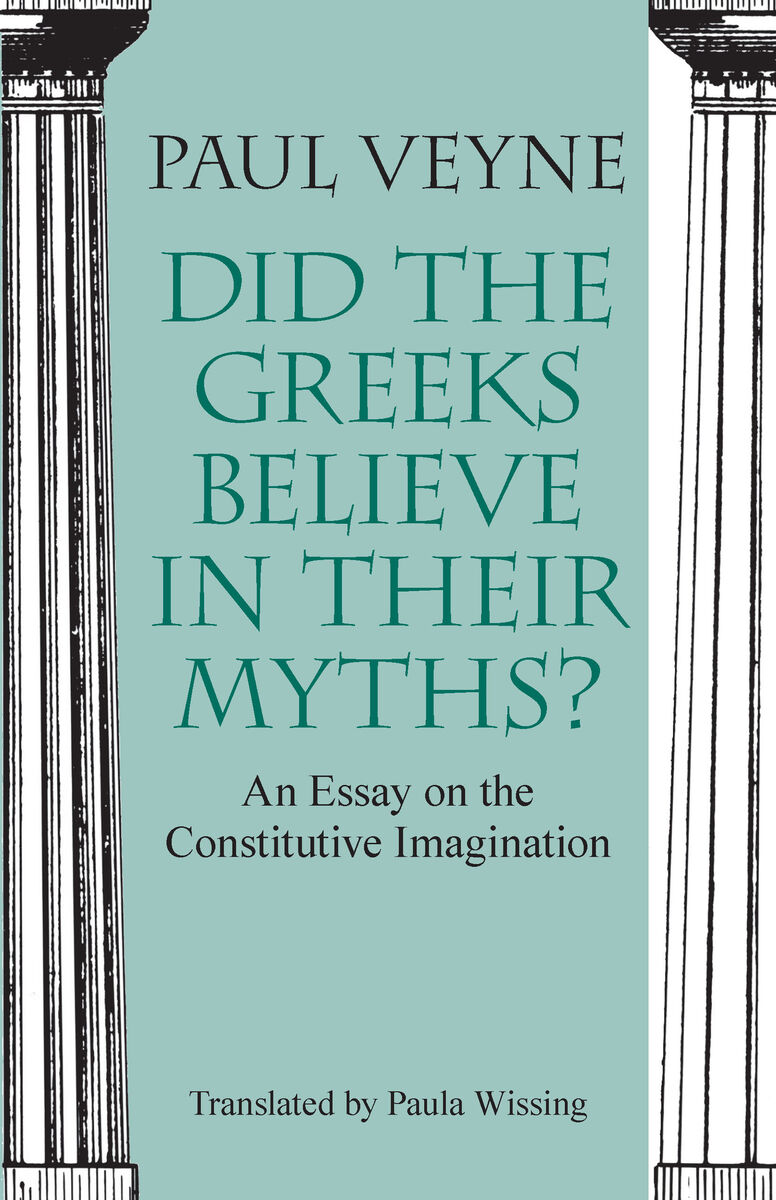
Did the Greeks Believe in Their Myths?
An Essay on the Constitutive Imagination
Did the Greeks Believe in Their Myths?
An Essay on the Constitutive Imagination
A groundbreaking, innovative exploration of what the ancient Greeks really believed
Did the Greeks believe in their mythology? This question implies other difficult ones concerning the meaning of belief. While knowing that Theseus never slew the Minotaur, the Greeks were still capable of believing in the existence of Theseus, of crafting a genealogy for him and assigning him a place in history. This apparently contradictory process, the application of reason to myth, prompts legendary archaeologist Paul Veyne’s meditation on the nature of “truth.” Beginning with the example of the Greeks’ attitude toward their myths, Veyne argues that truth is not found, but created, as is history. His discussion reveals the historical quality of the imagination and its role in the constitution of a cultural tradition.
169 pages | 5.50 x 8.50 | © 1988
Literature and Literary Criticism: Classical Languages
Philosophy: Philosophy of Religion
Reviews

Table of Contents
Preface
Introduction
1. When Historical Truth Was Tradition and Vulgate
2. The Plurality and Analogy of True Words
3. The Social Distribution of Knowledge and the Modalities of Belief
4. Social Diversity of Beliefs and Mental Balkanization
5. Behind This Sociology an Implicit Program of Truth
6. Restoring Etiological Truth to Myth
7. Myth and Rhetorical Truth
8. Pausanias Entrapped
9. Forger’s Truth, Philologist’s Truth
10. The Need to Choose between Culture and Belief in a Truth
Notes
Index