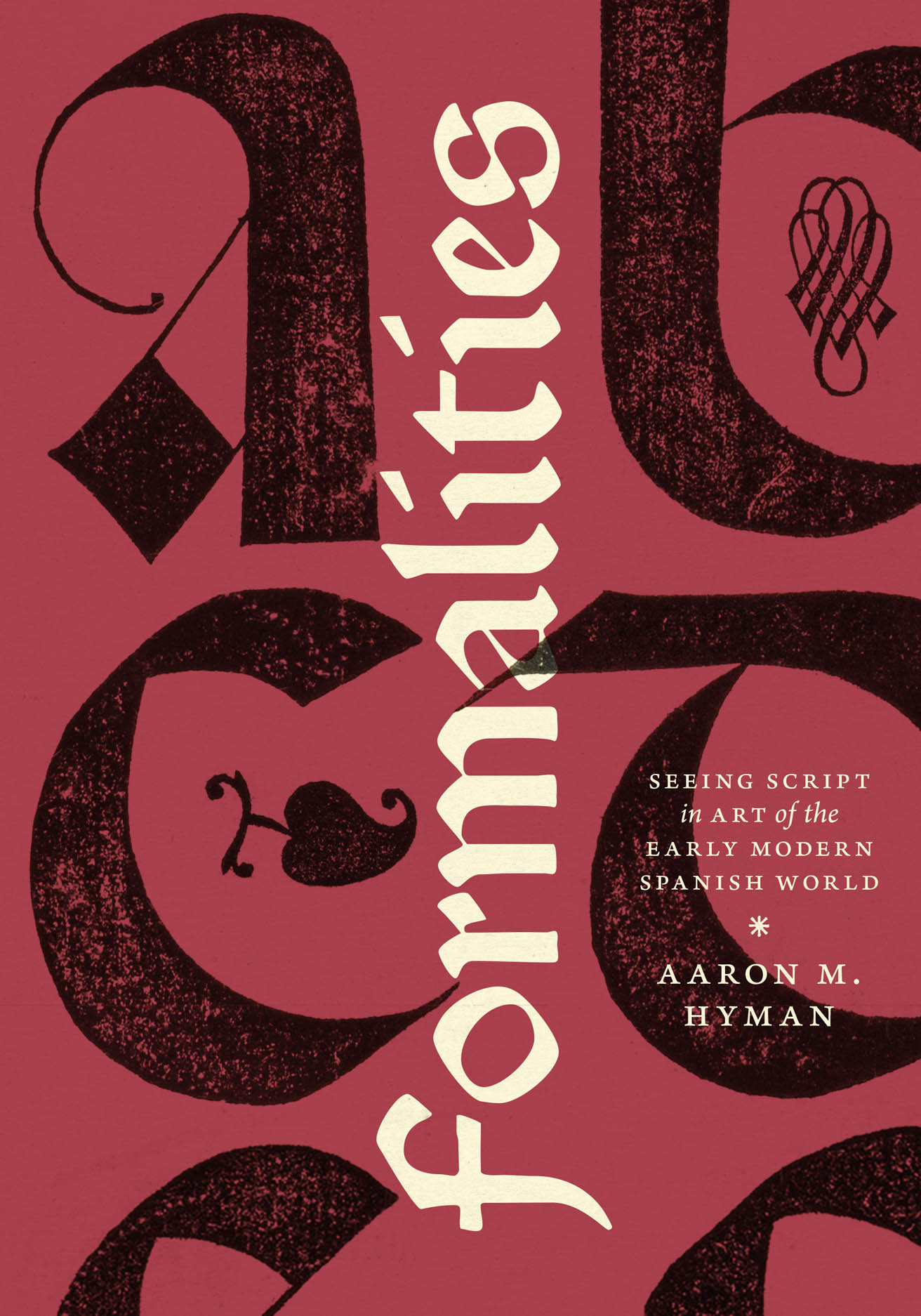
Formalities
Seeing Script in Art of the Early Modern Spanish World
Formalities
Seeing Script in Art of the Early Modern Spanish World
Examines the visual qualities of written words in works of art created from 1540 to 1700 across the transatlantic Spanish Empire.
Pieces of text are found across paintings produced in the early modern Spanish Empire, but their role as aesthetic elements has long been overlooked. With Formalities, Aaron M. Hyman argues that these words were important, not only because of their literal content but also because of their forms, which artists and their audiences across the Spanish world understood in terms of meanings beyond semantic content.
The widespread phenomenon of writing in or on works of art is one of the most distinctive features of art in the early modern Spanish world, yet it has received little art historical attention. Hyman focuses on this feature, demonstrating how artists mobilized particular scripts and carefully integrated the pictorial qualities of the written word. He explores how letterforms of the era were strictly codified, with different forms being particular to different genres and contexts. Chapters look at painted, embroidered, and incised words alongside texts in archival documents, books, and prints, showing how the visual arts drew on sources including calligraphy manuals, notarial documents, merchant account books, liturgical texts, and pictograms. Artists relied on their audiences’ understanding of the contexts in which such objects were used and connotations that texts thus produced, using visual languages to make meaning in addition to—or in spite of—what the words themselves actually said.
288 pages | 117 color plates, 3 halftones | 7 x 10
Art: Art--General Studies, European Art
History: History of Ideas, Latin American History
