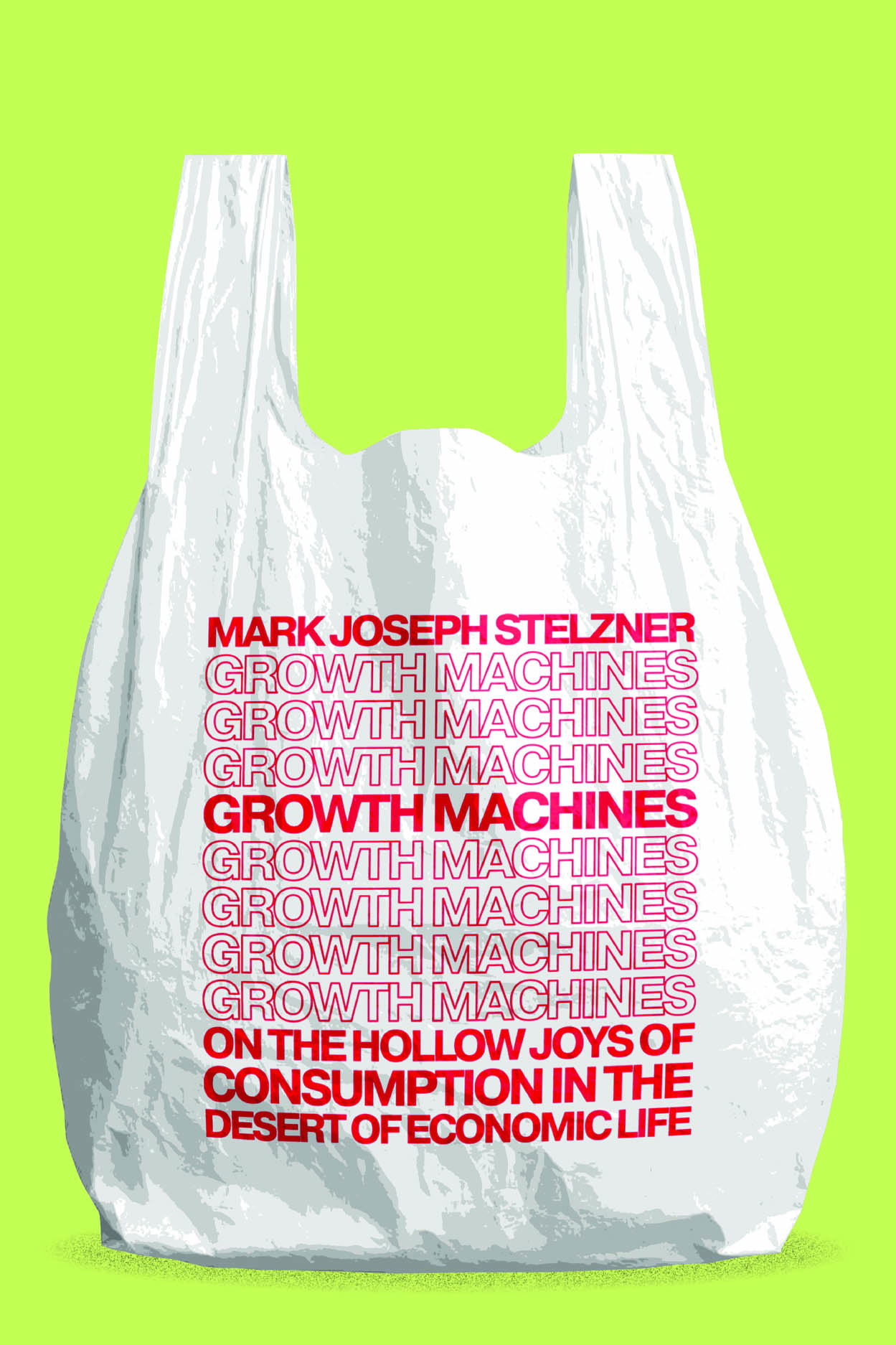
Growth Machines

On the Hollow Joys of Consumption in the Desert of Economic Life

Growth Machines

On the Hollow Joys of Consumption in the Desert of Economic Life

A provocative look at America’s compulsion to consume and our obsession’s surprising—and strange—origins.

In a capitalist society, people sell their labor to purchase staples like food, shelter, and anxiety medication. That’s the equation of everyday economic life that we’ve always been told is true. Except, is it really that simple anymore? No matter how unmaterialistic you may think you are, odds are that deep within is a drive to consume because it feels good: books you won’t read, clothes you won’t like and might wear even less, a replacement phone whose novelty runs out as quickly as its upgrade hits the market. But what drives this impulse?

In Growth Machines, Mark Joseph Stelzner shows how today’s consumers are now programmed by a US economy intent on infinite growth to work for goods they’ve been convinced they need and conditioned to want. Stelzner establishes the gaps between economic thinking and economic reality, arguing that consumption is no longer just a reflection of needs, but rather, it reflects a need for transaction—in many cases, a treat we seek out because it feels good. We work not only to be able to consume the essentials for living, but also to consume for consumption’s sake. Yet such consumption doesn’t make us happier. Stelzner traces this strange nature of consumption to an environmental source: an economy that demands growth. To keep its economy pumping, the US must keep Americans consuming. This makes Stelzner’s book an uncomfortable reflection on how we internalize our economy. To be an American is to consume; to consume is what makes America.


304 pages | 8 halftones, 1 tables | 6 x 9 | © 2026

Economics and Business: Economics--General Theory and Principles

Reviews

“How did we come to associate well-being with ever increasing levels of consumption and then make that relationship axiomatic to economic theorizing? Stelzner’s fast-paced history explores this revolution in thought and life, charting its social and ecological costs, to allows us to think anew about what makes for a good life. Brilliant and fresh, Growth Machines is a must-read for students of economic life.”

Sven Beckert | author of "Capitalism: A Global History"

“A must-read on conspicuous consumption and the birth of growthism."

Thomas Piketty | author of "A Brief History of Equality"

"Why do we keep working harder and spending more, even when it makes us no happier? In Growth Machines, economist Mark Joseph Stelzner offers a bracingly clear answer: because the system is designed that way. From the social anxieties that drive conspicuous consumption to the tech giants that profit by manufacturing desire, Stelzner lays bare how capitalism has stopped serving human welfare and started serving its own endless expansion—a treadmill we can’t seem to slow down or step off. Urgent, accessible, and quietly radical, this is the book for anyone who has ever felt hollowed out by the chase."

Mark Paul | author of "The Ends of Freedom: Reclaiming America’s Lost Promise of Economic Rights"

“Consumption promises happiness—but rarely delivers it. In this lucid and provocative book, Stelzner reveals how our desires are socially produced and exploited, trapping us in cycles of overwork and overconsumption. A powerful critique of growth-centered capitalism, this book challenges us to rethink the meaning of prosperity in an age of ecological crisis.”

Kohei Saito | author of "Slow Down: The Degrowth Manifesto"

“Stelzner provides a unique critique of capitalism by focusing specifically on consumption. In Growth Machines he examines the reasons that individuals overconsume in terms of their own good, the effects of overconsumption on society (both individually and collectively), and how capitalism both encourages and feeds on overconsumption. Stelzner also critically considers a number of possible solutions, from incremental to whole system-wide reform.”

Mark D. White | College of Staten Island, City University of New York

Table of Contents

Chapter 1. Why Consume?
Chapter 2. The Gains from Being Conspicuous
Chapter 3. Conspicuous Consumption and Capitalism
Chapter 4. On Irrationality
Chapter 5. Deceit, Manipulation, and Capitalism
Chapter 6. The Addictions of Consumption
Chapter 7. Environmental Degradation
Chapter 8. Environmental Degradation and Capitalism
Chapter 9. Consumers and Workers
Chapter 10. The Birth of Growthism
Chapter 11. What Are Basics?
Chapter 12. Rethinking Consumption
Acknowledgments
Notes
References
Index

Be the first to know

Get the latest updates on new releases, special offers, and media highlights when you subscribe to our email lists!

Sign up here for updates about the Press