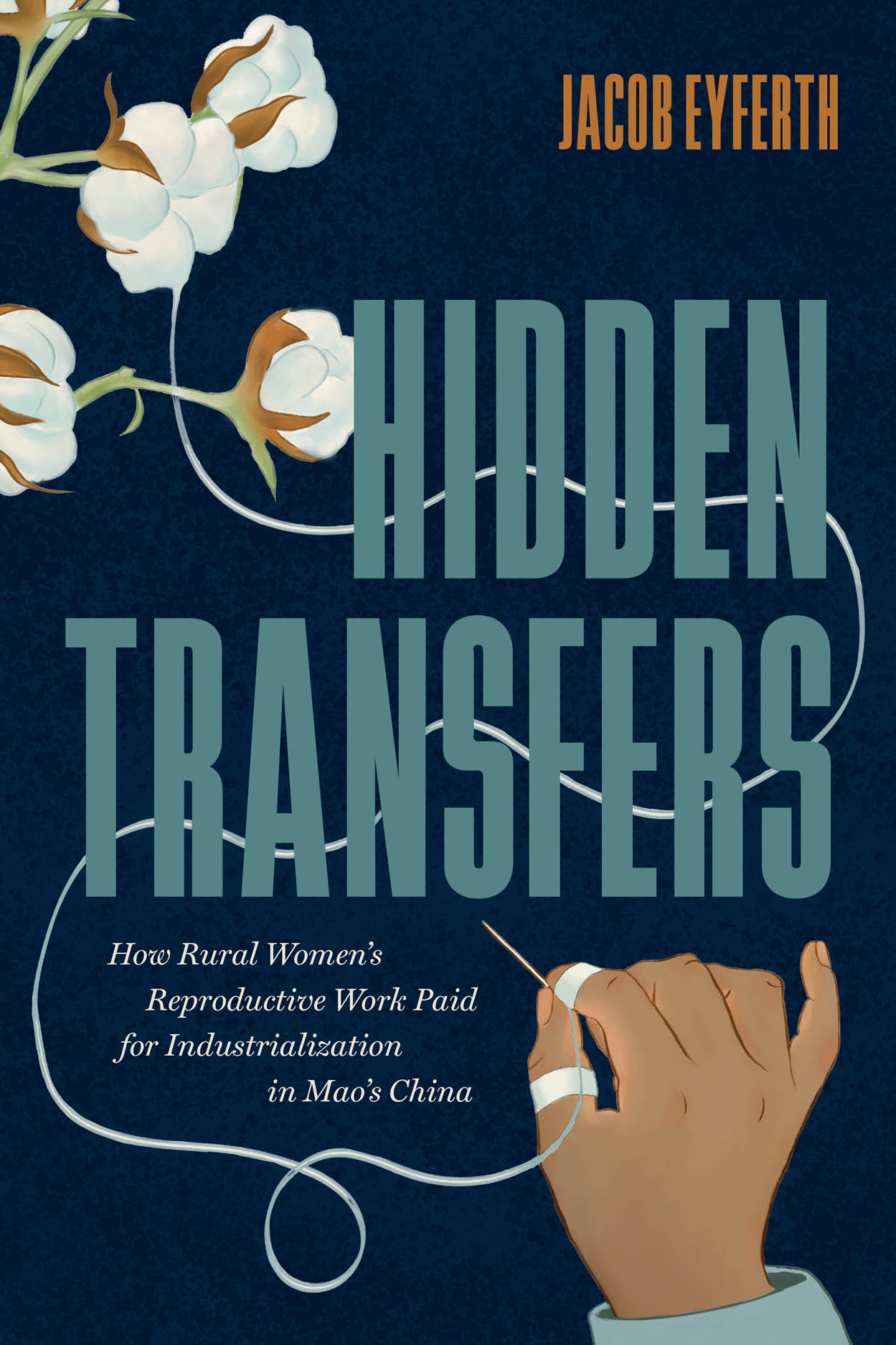
Hidden Transfers
How Rural Women’s Reproductive Work Paid for Industrialization in Mao’s China
Hidden Transfers
How Rural Women’s Reproductive Work Paid for Industrialization in Mao’s China
Provides a striking, new interpretation of the importance of rural women’s cloth production in collective-era China.
Based on extensive archival research, fieldwork across multiple villages, and hundreds of interviews, Hidden Transfers offers a material history of the working lives of rural women in communist China from 1949 to 1983.
Focusing on cotton cultivation and manual textile production in rural households, historian Jacob Eyferth examines the relationship between domestic labor and socialist development by recovering the story of the millions of women who spent countless hours spinning yarn, weaving cloth, and making clothes for their families. He shows how the “hidden transfers” from the domestic economy to fund accumulation rested, as with capitalist economies, on women’s unpaid domestic work. But state socialism went even further, celebrating the future-making work of production while disparaging work that reproduced life at home. Through careful research, Eyferth tracks how the Chinese state’s project of primitive accumulation, in turn, created the conditions for the spectacular growth experienced in the post-Mao years.
320 pages | 12 halftones, 3 tables | 6 x 9
Asian Studies: East Asia, General Asian Studies
History: Asian History, General History

Table of Contents
Introduction
1. Visions of Women’s Work in Late Imperial and Republican China
2. Cotton Cultivation Between the Household Economy and the State
3. The Struggle for the Cotton Harvest
4. Labor Intensification in the Cotton Fields
5. Scarcity, Substitution, and Overwork in the Rural Household
6. Underconsumption and Overwork Beyond Guanzhong
Conclusion
Acknowledgments
Appendix 1
Appendix 2
Glossary of Chinese Characters
Notes
Bibliography
Index