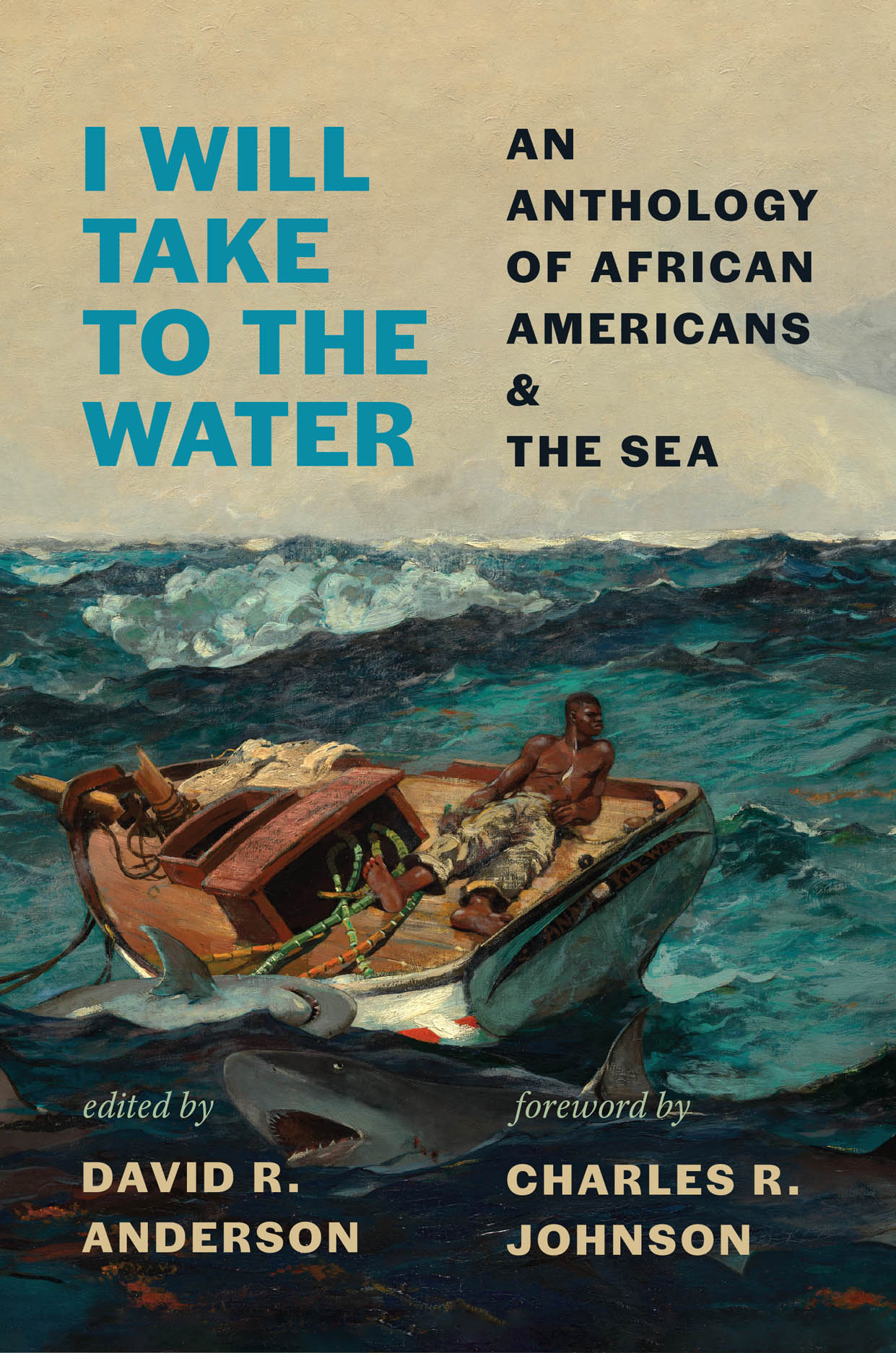
I Will Take to the Water
An Anthology of African Americans and the Sea
I Will Take to the Water
An Anthology of African Americans and the Sea
A landmark survey of African American literature about Black experiences of the maritime environment.
The ocean is foundational to the story of Africans in America, beginning with the searing Middle Passage. Initially evoking terror, pain, and death, the ocean also became associated with escape, empowerment, freedom, and home, as over time, African Americans in seaport towns found work, built communities, and gained knowledge from travelers. David R. Anderson shows in this groundbreaking collection of memoir, fiction, poetry, and more that African American maritime literature summons many of the traditional themes—survival in the face of overwhelming natural force, sublimity, demonstration of skill and merit, and self-discovery—but often with an eye on legacies of imperialism, slavery, discrimination, and cultural erasure.
Divided thematically across ten sections that address peril, labor, recreation, and more, the book gathers work by influential writers and intellectuals from the eighteenth century to the present, including: Lucille Clifton, Edwidge Danticat, Frederick Douglass, Alice Dunbar-Nelson, W. E. B. DuBois, Camille T. Dungy, Marcus Garvey, Robert Hayden, Zora Neale Hurston, Major Jackson, Harriet Jacobs, John S. Jacobs, Nella Larsen, Claude McKay, Toni Morrison, Walter Mosley, Natasha Trethewey, Phillis Wheatley, Colson Whitehead, and Kevin Young.
432 pages | 12 halftones | 6 x 9 | © 2026
History: American History
Literature and Literary Criticism: American and Canadian Literature
Reviews

Table of Contents
Foreword by Charles Johnson
Introduction by David R. Anderson
1. Middle Passage
Olaudah Equiano, from chapter 2 of The Interesting Narrative of the Life of Olaudah Equiano, or Gustavus Vassa, the African. Written By Himself (1789, 1794)
Venture Smith, from chapter 1 of A Narrative of the Life and Adventures of Venture, a Native of Africa: But Resident Above Sixty Years in the United States of America. Related by Himself (1798)
Zora Neale Hurston, chapter 6, “Barracoon,” of Barracoon: The Story of the Last “Black Cargo” (2018)
Robert Hayden, “Middle Passage” (1945, 1962)
Paule Marshall, from part 1, chapter 3 of Praisesong for the Widow (1983)
Lucille Clifton, “atlantic is a sea of bones” (1987)
Elizabeth Alexander, “Absence” (2005)
Douglas Kearney, “Swimchant for Nigger Mer-Folk (An Aquaboogie Set in Lapis)” (2009)
2. Perilous Journeys
Phillis Wheatley, “A Farewel to America. For Mrs. S. W.” (1773)
Olaudah Equiano, from chapter 6 of The Interesting Narrative of the Life of Olaudah Equiano, or Gustavus Vassa, the African. Written By Himself (1789, 1794)
Moses Grandy, from Narrative of the Life of Moses Grandy; Late a Slave of the United States (1843)
Zilpha Elaw, from Memoirs of the Life, Religious Experience, Ministerial Travels, and Labours of Mrs. Zilpha Elaw, An American Female of Colour; Together with Some Account of the Great Religious Revivals in America (1846)
Nancy Prince, from A Narrative of the Life and Travels of Mrs. Nancy Prince (1850)
Daniel Payne, from chapter 8, “A Disastrous Voyage,” of Recollections of Seventy Years (1888)
James H. Williams, from “An Indian Hurricane” (1907)
Lucille Clifton, “blessing the boats” (1991)
3. Sea of Freedom
Frederick Douglass, from chapter 10 of Narrative of the Life of Frederick Douglass, an American Slave. Written by Himself (1845)
Frederick Douglass, from part 4 of The Heroic Slave (1853)
James Whitfield, “Stanzas for the First of August” (1849, 1853)
John Swanson Jacobs, chapter 8 of The United States Governed by Six Hundred Thousand Despots (1855)
Harriet Jacobs, chapter 30, “Northward Bound,” of Incidents in the Life of a Slave Girl, Written by Herself (1861)
Martin Delany, chapter 47, “Significant,” of Blake; or The Huts of America (1862)
William Still, “Crossing the Bay in a Batteau,” of The Underground Railroad (1872)
Josephine Delphine Henderson Heard, “General Robert Smalls” (1890)
Sutton E. Griggs, from chapter 27 of Overshadowed (1901)
Kevin Young, “Friendship” (2011)
4. The Search for a Better Place
Peter Williams Jr., from “A Discourse Delivered on the Death of Capt. Paul Cuffee, Before the New York African Institution, in the African Methodist Episcopal Zion Church, October 21, 1817” (1818)
J. Dennis Harris, letter 1, “Dominican Republic,” of A Summer on the Borders of the Caribbean Sea (1860)
James Williams, from The Life and Adventures of James Williams, A Fugitive Slave (1873)
Mifflin Wistar Gibbs, from chapter 3 of Shadow and Light: An Autobiography with Reminiscences of the Last and Present Century (1902)
Marcus Garvey, “An Appeal to the Colored People of New York by the Black Star Line Steamship Corp.” (early 1920s)
Nella Larsen, chapter 12 of Quicksand (1928)
William Jourdan Rapp and Wallace Thurman, act 3, scene 1 of Jeremiah the Magnificent (1929)
Langston Hughes, from The Big Sea (1940)
Edwidge Danticat, “Children of the Sea” (1995)
5. Work and the Sea
William P. Powell, “Head Wind for Sailors” (mid-1840s)
Frederick Douglass, from chapter 10 of Narrative of the Life of Frederick Douglass, an American Slave. Written by Himself (1845)
Frederick Douglass, from chapter 1, “The Author’s Childhood,” of My Bondage and My Freedom (1855)
John Thompson, from chapter 16, “Voyage to the Indian Ocean,” of The Life of John Thompson, a Fugitive Slave; Containing His History of 25 Years in Bondage, and His Providential Escape. Written by Himself (1856)
William J. Brown, from chapter 2 of The Life of William J. Brown, of Providence, R.I., with Personal Recollections of Incidents in Rhode Island (1883)
James H. Williams, “A Son of Ishmael” (1906)
James H. Williams, “Good ‘Old Summertime’” (1907)
Arna Bontemps, “Nocturne of the Wharves” (1928)
Chester Himes, “The Song Says ‘Keep on Smiling’” (1945)
Langston Hughes, “Sinking of the Titanic” (Overheard Variant) (1956)
Horace R. Cayton, from Long Old Road: An Autobiography (1963)
Hugh Mulzac, from chapter 11 of A Star to Steer By (1963)
Carl T. Rowan, from chapter 3 of Breaking Barriers: A Memoir (1991)
Harold Anderson, “Menhaden Chanteys: An African American Maritime Legacy” (2000)
Marilyn Nelson, “The Incident of the Clams” (2008)
Martha Southgate, from part 1, chapter 1 of The Taste of Salt (2011)
Thomas C. Fleming with Max Millard, “The Admiral Line” (2011)
6. The Pull of the Sea
Josephine Delphine Henderson Heard, “The City by the Sea” (1890)
George Marion McClellan, “Eternity” (1895, 1916)
Paul Laurence Dunbar, “The Wind and the Sea” (1896)
Helene Johnson, “Metamorphism” (1926)
Captain Harry Dean with Sterling North, from chapter 2, “I Go to Sea,” of The Pedro Gorino: The Adventures of a Negro Sea Captain in Africa (1929)
Dorothy West, from “Winter on Martha’s Vineyard” (ca. 1950)
Bob Kaufman, “The Celebrated White-Cap Spelling Bee” (ca. 1956–ca. 1963)
Conyus, “The Great Santa Barbara Oil Disaster, Or: A Diary” (1970, 2011)
Al Young, “Big Sur” (1992)
Afaa Michael Weaver, “My Father’s Geography” (1992)
Camille T. Dungy, “A Massive Dying Off” (2011)
7. Exploration
Olaudah Equiano, from chapter 9 of The Interesting Narrative of the Life of Olaudah Equiano, or Gustavus Vassa, the African. Written By Himself (1789, 1794)
Captain Michael A. Healy, from Report of the Cruise of the Revenue Steamer Corwin in the Arctic Ocean in the Year 1884 (1889)
Matthew A. Henson, chapter 3 of A Negro Explorer at the North Pole (1912)
Captain Harry Dean with Sterling North, chapter 5, “The Full Moon and Her Villainous Crew,” of The Pedro Gorino: The Adventures of a Negro Sea Captain in Africa (1929)
Claude McKay, from Banjo (1929)
Robert Hayden, “The Diver” (1962)
Walter Mosley, “The Wanderer” (1998)
Michael H. Cottman, prologue to The Wreck of the Henrietta Marie: An African-American’s Spiritual Journey to Uncover a Sunken Slave Ship’s Past (1999)
8. Recreation and Rights
Fanny Jackson Coppin, from Reminiscences on School Life, and Hints on Teaching (1913)
W. E. B. Du Bois, from chapter 9, “Of Beauty and Death,” of Darkwater: Voices from Within the Veil (1920)
Wallace Thurman, from part 1, “Emma Lou,” of The Blacker the Berry: A Novel of Negro Life (1929)
Alice Dunbar-Nelson, from “As in a Looking Glass” column (1929)
John H. Paynter, chapter 1, “Then and Now,” of Fifty Years After (1940)
Wanda Coleman, “Beaches. Why I Don’t Care for Them” (1979)
Jewelle Gomez, “A Swimming Lesson” (1993)
Colleen McElroy, from A Long Way from St. Louie (1997)
Gilbert R. Mason with James Patterson Smith, from chapter 5, “The Bloody Wade-In,” of Beaches, Blood, and Ballots: A Black Doctor’s Civil Rights Struggle (2000)
Colson Whitehead, from Sag Harbor (2009)
Major Jackson, “On Cocoa Beach” (2015)
9. Love and Longing
Alice Dunbar-Nelson, “At Bay St. Louis” (1895)
Alice Dunbar-Nelson, “The Fisherman of Pass Christian” (1899)
Pauline Hopkins, “A Dash for Liberty” (1901)
William Stanley Braithwaite, “The Watchers” (1904)
Eric Walrond, “The Wharf Rats” (1926)
Toni Morrison, from chapter 4, “Benefactor,” of Love (2003)
Kiki Petrosino, “Hymn for the Black Terrific” (2013)
Donika Kelly, “Love Poem: Mermaid” (2016)
Camille T. Dungy, “Frequently Asked Questions #9” (2017)
10. History and Remembrance
Michael S. Harper, “American History” (1970)
Henry Dumas, “Ark of Bones” (1970)
Henry Dumas, “Black Star Line” (1974)
Charles Johnson, from “Entry the Second: June 20, 1830,” in Middle Passage (1990)
August Wilson, from act 2, scene 2 of Gem of the Ocean (2006)
Natasha Trethewey, “Elegy for the Native Guards” (2006)
Joy Priest, “Ghosts in Schools” (2021)
Acknowledgments
Bibliography: Primary Sources and Further Reading
Selected Timeline
Index