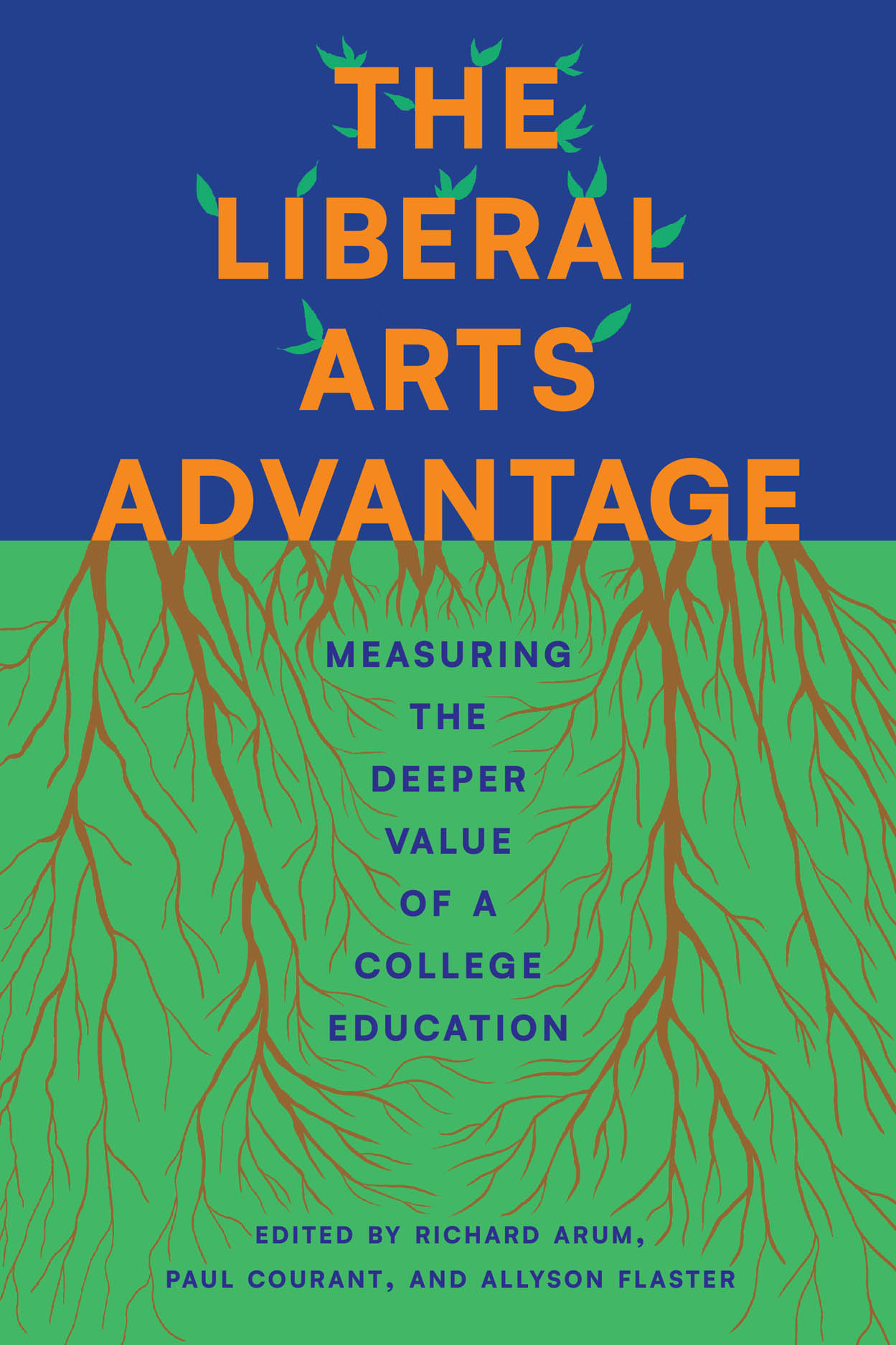
The Liberal Arts Advantage
Measuring the Deeper Value of a College Education
The Liberal Arts Advantage
Measuring the Deeper Value of a College Education
Showcases new measurement strategies for assessing the impact of a liberal arts education on students and society.
More than ever before, our society is questioning the meaning and value of higher education, and liberal arts education, in particular, has come under substantial scrutiny. Economic detractors characterize liberal arts education as impractical, claiming that college should prepare students for the workforce. Others object to the curriculum, portraying it as broken or misdirected. According to these critics, the liberal arts education being offered in the United States is marked by its rejection of core intellectual and ideological commitments.
In The Liberal Arts Advantage, a wide range of scholars argue for how and why a liberal arts education uniquely develops skill sets and expertise needed for individuals and society to thrive in the twenty-first century. The contributors address foundational questions about what liberal arts education is, how it has been conceptualized in the past, and what we can learn from its societal and professional impacts. They present compelling, unique research and new methodological tools for assessing the outcomes of liberal arts graduates. Offering grounded and well-founded arguments in favor of our education system, The Liberal Arts Advantage persuasively explains why educational leaders should reinvest in liberal arts education.
432 pages | 50 halftones, 32 tables | 6 x 9
Economics and Business: Economics--Econometrics and Statistics
Education: Curriculum and Methodology, Higher Education
Sociology: Social Institutions
Reviews

Table of Contents
1. The Liberal Arts Advantage: Defining, Measuring, and Advancing the Field amid Contemporary Challenges
Richard Arum, Paul Courant, and Allyson Flaster
2. Measuring the Effects of a Liberal Arts Education: Conceptual and Normative Issues
Harry Brighouse and Michael McPherson
3. Conceptualizing Breadth and Depth in Liberal Arts Education
Jennifer Brady
4. Education in the Arts and Humanities: Relevance for Well-Being, Health, and Widening Inequality
Carol D. Ryff
5. The Relationship Between a Liberal Arts Education and Democratic Outcomes
Paula McAvoy, David Campbell, and Diana Hess
6. Studying the Development of Student Purpose in American Colleges and Universities
William Damon and Heather Malin
7. Canary in the Coal Mine: Warning Signs and Opportunities for Higher Education
Wendy Fischman, Sophie Blumert, and Howard Gardner
8. Diversity, Equity, and Inclusion in the Liberal Arts Education Experience and Beyond: College Student Diversity Experiences and Their Postgraduation Outcomes
W. Carson Byrd, Eugene T. Parker, and Rebecca E. Crandall
9. The Economic Returns to a Liberal Arts Education
Catharine Bond Hill, Elizabeth Davidson Pisacreta, and Daniel Rossman
10. Measuring the Liberal Arts in the Age of Big Data: Lessons and Opportunities from Computational Social Science
Annaliese Paulson
11. Conceptual Recombination as a Distinctive Feature of Liberal Arts Curriculum
Siqi Han, Jack LaViolette, Chad Borkenhagen, William McAllister, and Peter Bearman
12. Measuring Liberal Arts Education with a Comprehensive, Integrated Campus Dataset
Richard Arum, Maria Calderon Leon, David Chang, Jacquelynne Eccles, Jutta Heckhausen, Luise von Keyserlingk, Xunfei Li, Oded Mcdossi, and Gabe Avakian Orona
13. Educating for Virtuous Intellectual Character
Gabe Avakian Orona and Duncan Pritchard
14. Infrastructural Gaps and the Creation of Trusted Data Intermediaries
James Shulman
15. The Centrality of Liberal Arts Education in Mediating the Two Cultures of the Contemporary University: Meritocracy and Inclusive Excellence
Douglas Haynes
16. What Next for the Liberal Arts?
Mitchell L. Stevens
Acknowledgments
References
Contributors
Index