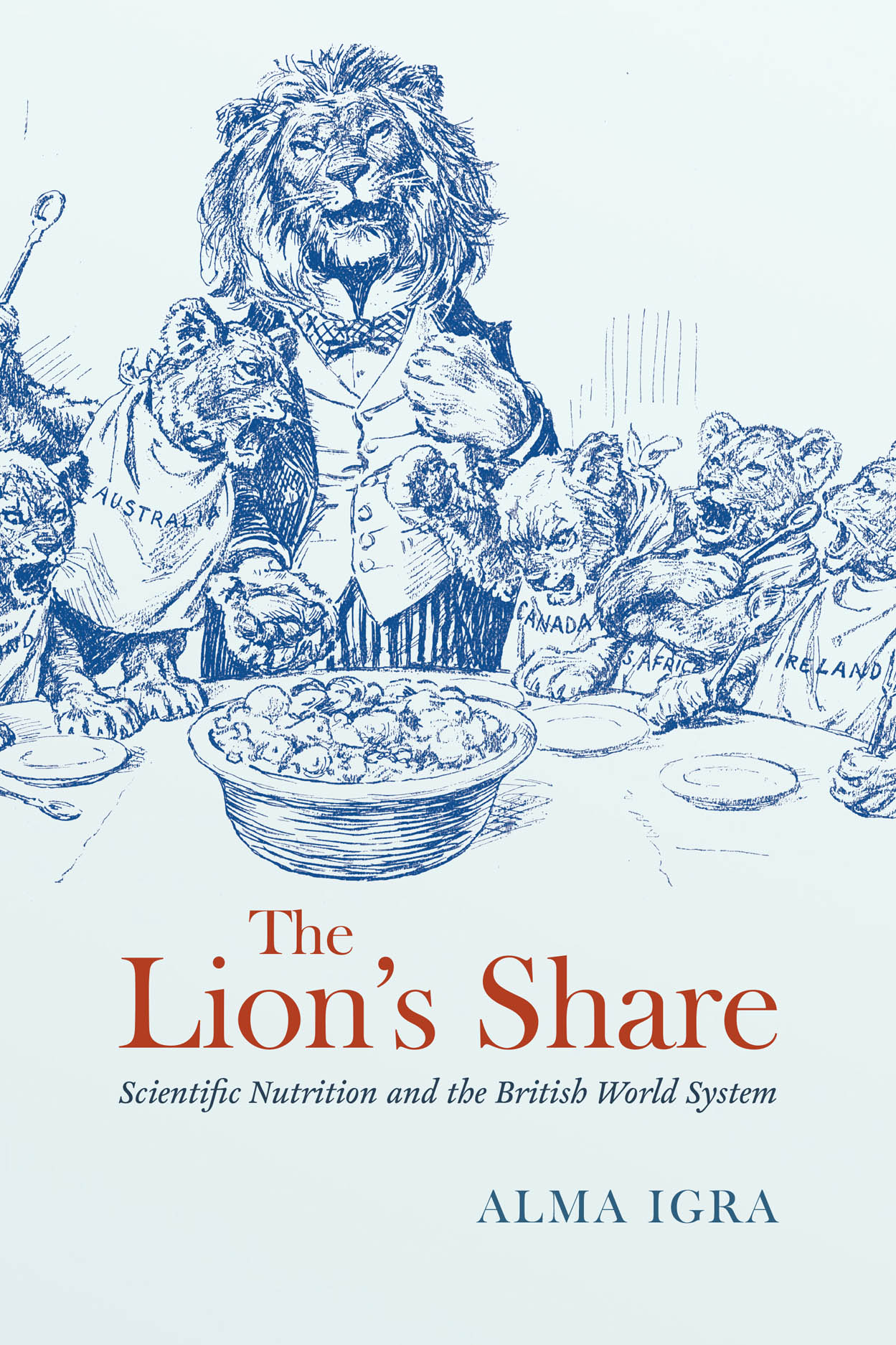
The Lion’s Share
Scientific Nutrition and the British World System
The Lion’s Share
Scientific Nutrition and the British World System
Publication supported by the Bevington Fund
Reveals how nutrition science emerged from Britain’s attempts to mold the food chain to its imperial interests.
The Lion’s Share offers a biography of nutrition as a scientific discipline, from its imperial birth, through its rise to fame, to its integration into an environmental and political global order. Even though medical knowledge involved food since ancient times, at the beginning of the twentieth century, nutrition was not yet a scientific discipline in an institutional or practical sense. Nevertheless, by the 1930s, it was one of the most politically influential scientific fields, with nutritionists operating as medical diplomats within national, international, and imperial organizations. As historian Alma Igra explains, it is through the global networks of British power that a decidedly marginal field of technical knowledge concerned with agricultural productivity and animal feeding evolved into an area of expertise governing the human diet and related issues of public health, economic development, and humanitarian aid.
The Lion’s Share visits five pivotal moments that prompted new nutritional research at transnational meetings in Scotland, Iraq, Vienna, Geneva, and the Netherlands. Through the eyes of the experts, Igra tracks how nutrition became an international science, with mobile labs, collaborations among institutions, and a constant clash between local and imperial practices. Standardization of food measurement created new ways for food to be international and allowed politicians to imagine the world as one. Yet tensions remained that shaped international policy in the twentieth century and still affect international land policy today.
240 pages | 16 halftones, 2 tables | 6 x 9 | © 2026
Reviews

Table of Contents
List of Abbreviations
Introduction
Chapter 1. Productive Creatures: Scientific Agriculture, Imperial Lands, and the First Institute for Nutrition
Chapter 2. Competition and Difference: Race, Animals, and Scarcity in Nutritional Studies of World War I
Chapter 3. Milk and Standards in Exchange: Calories in Vienna and the Quest for International Nutrition
Chapter 4. From London to Geneva and Back: Vitamin Standardization
Chapter 5. Blood, Bones, and the Borders: British Nutrition Experts and Wartime Planning of Europe
Epilogue: The White Man’s Dilemma
Acknowledgments
Notes
Bibliography
Index