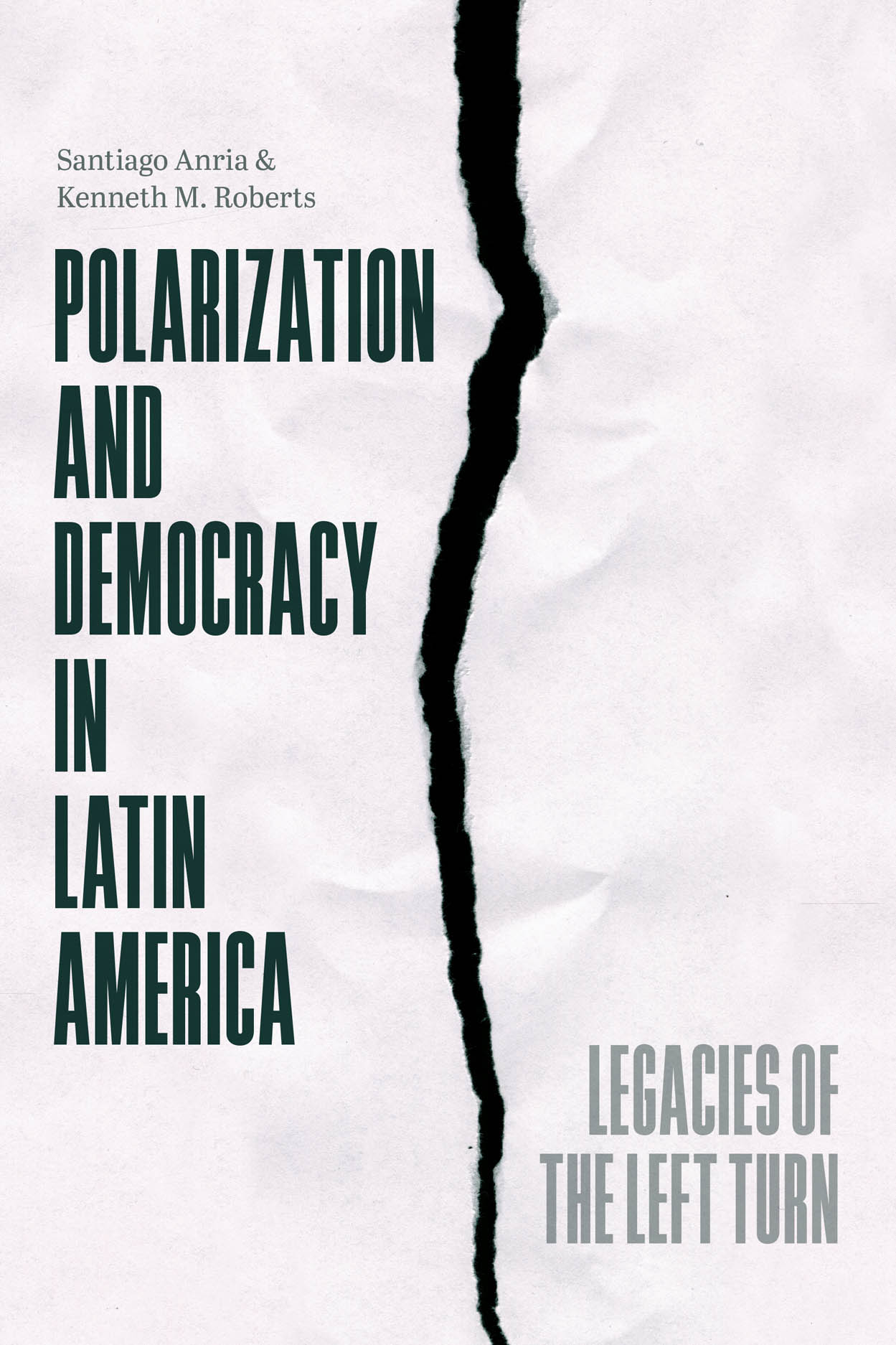
Polarization and Democracy in Latin America

Legacies of the Left Turn

An insightful examination of Latin America’s contemporary democratic landscape and how it is marked by patterns of polarization and volatility.

Although Latin American democracies have shown considerable resilience, today they face new forms of political polarization and instability. These challenges are closely connected to the legacies of the region’s “left turn,” which sought to transform entrenched inequalities and social hierarchies in the early twenty-first century. Unprecedented in its scope and duration, the left turn reflected an underlying realignment of political contestation in a highly unequal region. Yet despite notable achievements in addressing social needs, leftist parties struggled to deepen democracy by empowering popular majorities, and they faced powerful elite backlashes.

Through a comparative analysis of seven South American countries, Santiago Anria and Kenneth M. Roberts trace the different origins and trajectories in power of the populist and social democratic currents that emerged within the left turn. Anria and Roberts argue that today’s democratic orders face intensifying polarization and institutional fragility, even where social democratic parties made explicit efforts to build broad coalitions and temper political conflict. They show how activist networks and social movements on the left and the right triggered latent political conflicts and are now reshaping democratic competition and the terms of social inclusion in South American politics.


280 pages | 8 halftones, 3 line drawings, 5 tables | 6 x 9

Political Science: Comparative Politics

Reviews

Polarization and Democracy is a brilliant, qualitative leap forward in our understanding of the relationship between the two in our turbulent times. With a clear eye, it anchors the root cause of present day polarization in an all too rarely acknowledged driver of Latin American politics: The push and pull of politics in highly unequal societies with hegemonic classes highly resistant to reform. Efforts to deepen democracy generate strong defensive reactions. The book then masterfully unpacks the dimensions of contemporary polarization and the mechanisms that drive it. In a triumph of historically grounded scholarship, it makes complex processes intelligible, setting the highest standard for the rest of us.”

Eduardo Silva | author of "Challenging Neoliberalism in Latin America"

“This book offers an insightful and much-needed analysis of the legacies of Latin America’s ’Left Turn.’ Drawing lessons from the sobering reality that both social democratic and radical left experiments often ended badly, Anria and Roberts highlight some of the core dilemmas--and structural limitations--facing the democratic left in Latin America. The book also makes a compelling case for rethinking polarization, showing that polarization is both necessary to democratic politics and an inevitable product of movement toward greater social and political inclusion in the region. I recommend this book to anyone interested in politics in contemporary Latin America.”

Steven Levitsky | Harvard University

“Combining a rich conceptual framework, terrific case studies, and longitudinal survey data, the authors provide a panoramic and powerful analysis of the rise, fall, and legacies of the Left Turn in Latin America. With a primary focus on the social democratic and populist left, they trace distinct comparative historical origins, democratic imaginaries, and political temptations. Yet, despite these differences, the authors highlight that both lefts ultimately faced polarizing elites, mass protest, and conservative backlash. Informed by the theoretical literature and an impressive command of the cases, they remind us that democracies and polarized conflict are not inherently at odds with one another. This is a powerful reminder that democracy is often forged on the shoals of conflict; alternation in power is expected, especially given enduring, multidimensional inequality and polarization; and democratic institutions are most nimble and healthy when political parties maintain strong social ties with their grassroot bases and avoid autocratic temptations. A powerful comparative analysis of political trajectories in the region and a clarion call for Left parties to engage in deep reflection on lessons learned.”

Deborah Yashar | author of "Homicidal Ecologies: Illicit Economies and Complicit States in Latin America"

Table of Contents

List of Illustrations
Introduction: Democracy and Polarization in Latin America
Chapter 1: The Left Turn, Democracy, and Dynamics of Polarization
Chapter 2: The Social Democratic Left and the Conformist Temptation
Chapter 3: The Populist Left and the Autocratic Temptation
Chapter 4: Comparative Perspectives: Argentina, Ecuador, and Uruguay
Chapter 5: Latin America’s “New” Polarization: A Multidimensional Approach
Conclusion: Polarization, Democracy, and the Leftist Dilemma
Acknowledgments
Appendix
Notes
References
Index

Be the first to know

Get the latest updates on new releases, special offers, and media highlights when you subscribe to our email lists!

Sign up here for updates about the Press