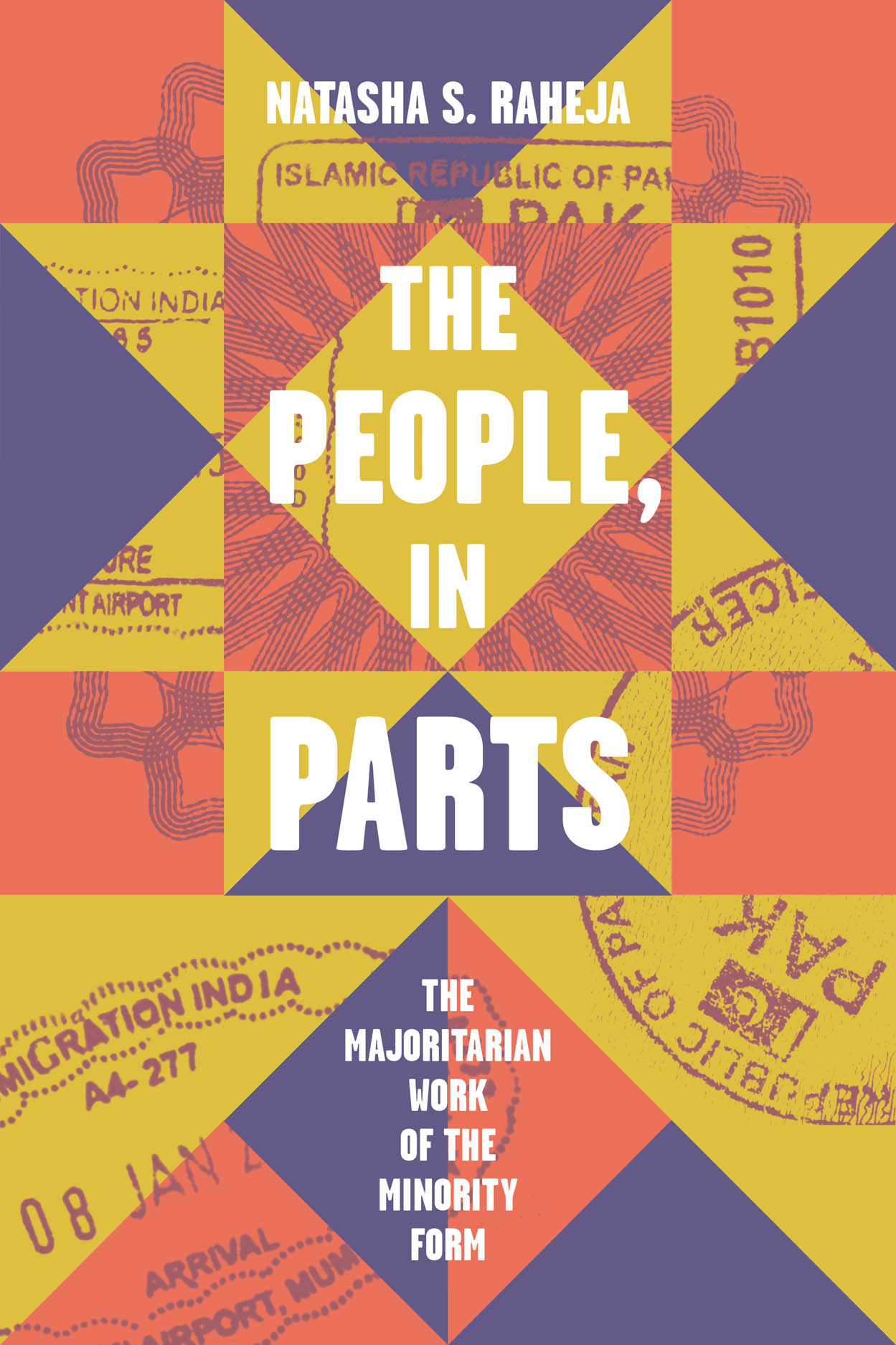
The People, in Parts
The Majoritarian Work of the Minority Form
The People, in Parts
The Majoritarian Work of the Minority Form
Offers a new theory of the minority as a political form and shows how majoritarian projects are built through its appropriation.
Around the world, national majorities are telling themselves a potent story: that they are the ones in danger. In the United States and Serbia, Christian and white nationalists warn of “replacement.” In Turkey and Pakistan, Muslim nationalists cast religious “others” as existential threats. In India, Hindu nationalists claim that Hindus are becoming minorities in “their own” land. These movements, and the migration and citizenship policies that accompany them, are not aberrations, but rather expressions of a logic embedded in the modern nation-state—a logic that turns people into numbers, numbers into votes, and difference into enmity.
In The People, in Parts, anthropologist Natasha S. Raheja homes in on a paradox visible along the India-Pakistan border. When Hindus cross into India from Pakistan seeking refuge, they are admitted as minorities in need of protection. Yet in India, their welcome into the putative majority is selective and conditional. How does majority-minority status shift by crossing a border? Drawing on long-term research in the Thar Desert region, across Sindh and Rajasthan, Raheja traces how caste and religion shape people’s encounters with the state and argues that this bureaucratic confusion is political machinery. Where liberal democracy treats the minority as a shifting, procedural category, nation-state governance fixes it as a substantive identity. The suffering of minoritized populations becomes raw material for majoritarian projects, converted into demographic justification, electoral arithmetic, and nationalist grievance. The minority form, in other words, does majoritarian work.
The People, in Parts offers not only a searing diagnosis of minority-majority politics and the governance of migration but a reframing: the problem is not simply about who belongs and who does not, but how nationalist belonging crosses state borders, pointing to strains within liberal democracy and the nation-state order.
272 pages | 10 color plates, 32 halftones | 6 x 9 | © 2027
Anthropology: Cultural and Social Anthropology
Asian Studies: General Asian Studies, South Asia
Reviews

Table of Contents
Preface: Before the Journey
Introduction: Majority-Minority Conversions
1. Selective Welcome
2. Making a Minority: Quantitative Conversion and the Bureaucratic Everyday
3. Governing by Proximity: Conversion at a Close Distance
4. Mediating Mobility: Brokering Conversion
5. Divided Loyalties: The Nation vs. National Security
6. Remainders: Rishtedari and Cross-Region Relatedness
Coda: Maddening Loops
Acknowledgments
Notes
Bibliography
Index
Awards
American Institute of Indian Studies: Joseph W. Elder Prize in the Indian Social Sciences
Won