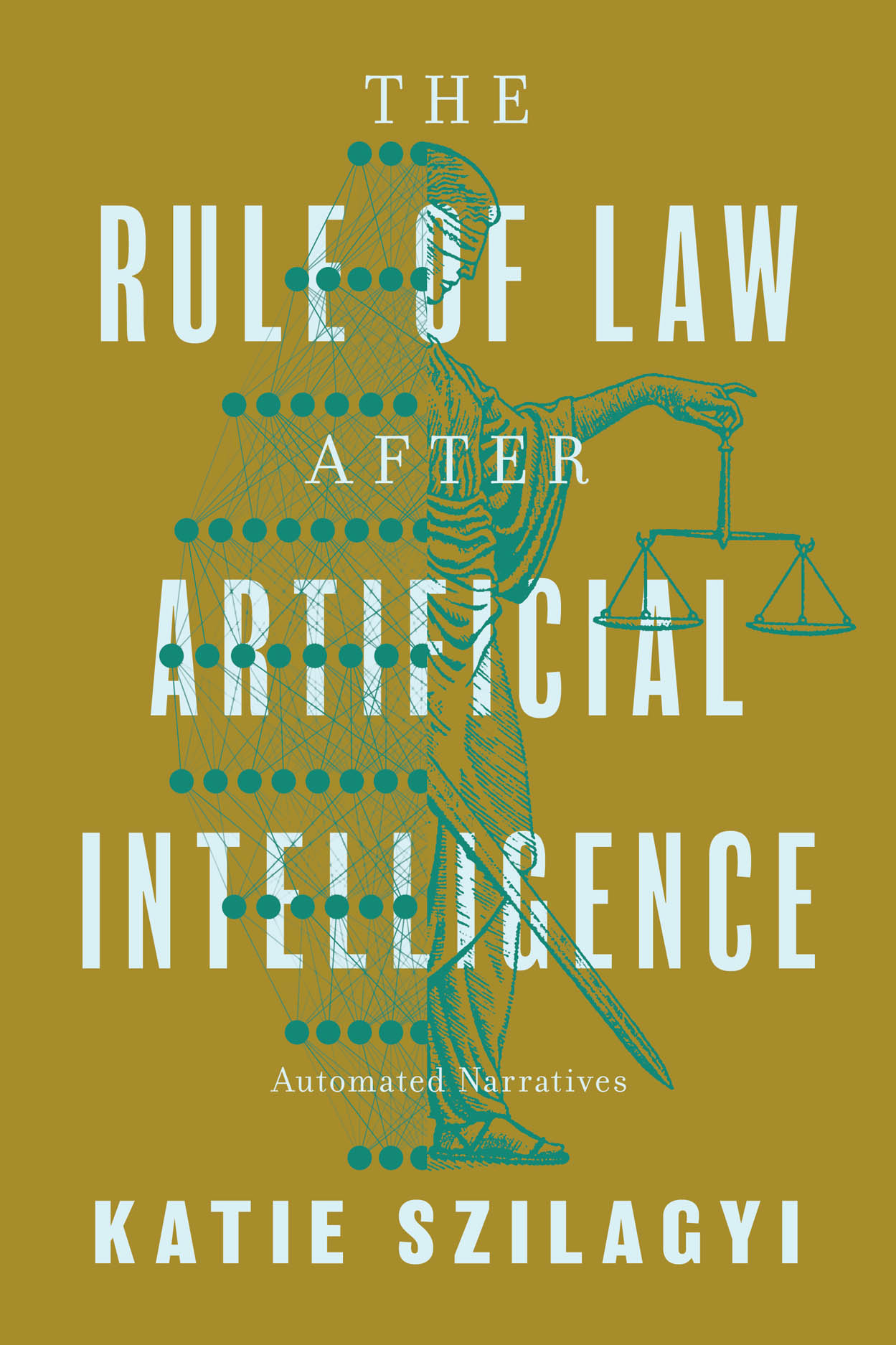
The Rule of Law After Artificial Intelligence
Automated Narratives
The Rule of Law After Artificial Intelligence
Automated Narratives
A timely investigation of what is at stake when AI takes legal decision-making out of human hands.
Artificial intelligence is proliferating in many professions, and the legal field is no exception. In The Rule of Law After Artificial Intelligence, Katie Szilagyi investigates the philosophical and practical implications of using AI in legal spaces, beginning with several fundamental questions: What is the law supposed to do, and from where does it derive its authority? Would law still achieve these aims if automated? How might automation affect the rule of law’s integrity and democratic institutions’ operations?
Blending legal philosophy, applied case studies, and insights from both critical legal scholarship and science and technology studies, Szilagyi argues that law and storytelling are deeply connected. Through creating and contesting the law, we make sense of the information around us and generate narratives about our collective world. These narratives are not static: legal precedent evolves, and legal deliberation on hard cases can help to resolve unclear or unprecedented social issues.
Szilagyi demonstrates that technological innovations make the rule of law vulnerable because large language models and machine learning undermine the visioning function of legal narratives, collapsing exercises of legal interpretation into mere administration. Datafication of law—built on the biased data of our cultural past—threatens longstanding legal ideals, lessens the constraints against abuses of power by private actors, and hamstrings society’s ability to reach a more egalitarian future. Szilagyi argues instead for centering narratives within the law and, in turn, rediscovering the tales the law tells us about who we are.
320 pages | 6 x 9 | © 2026
Law and Legal Studies: General Legal Studies, Law and Society, Legal Thought

Table of Contents
Introduction
Part I: Coding the Law
1. Introduction to Artificial Intelligence and Machine Learning
2. What Cyberlaw and Science and Technology Studies Might Teach
3. Delegating Decision-Making
Part II: Complicating the Law
4. The Rule of Law
5. Law as Narrative
Part III: Applying the Law
6. Sentencing Software
7. Facial Recognition Technology
8. Large Language Models
Conclusion
Acknowledgments
Notes
Index