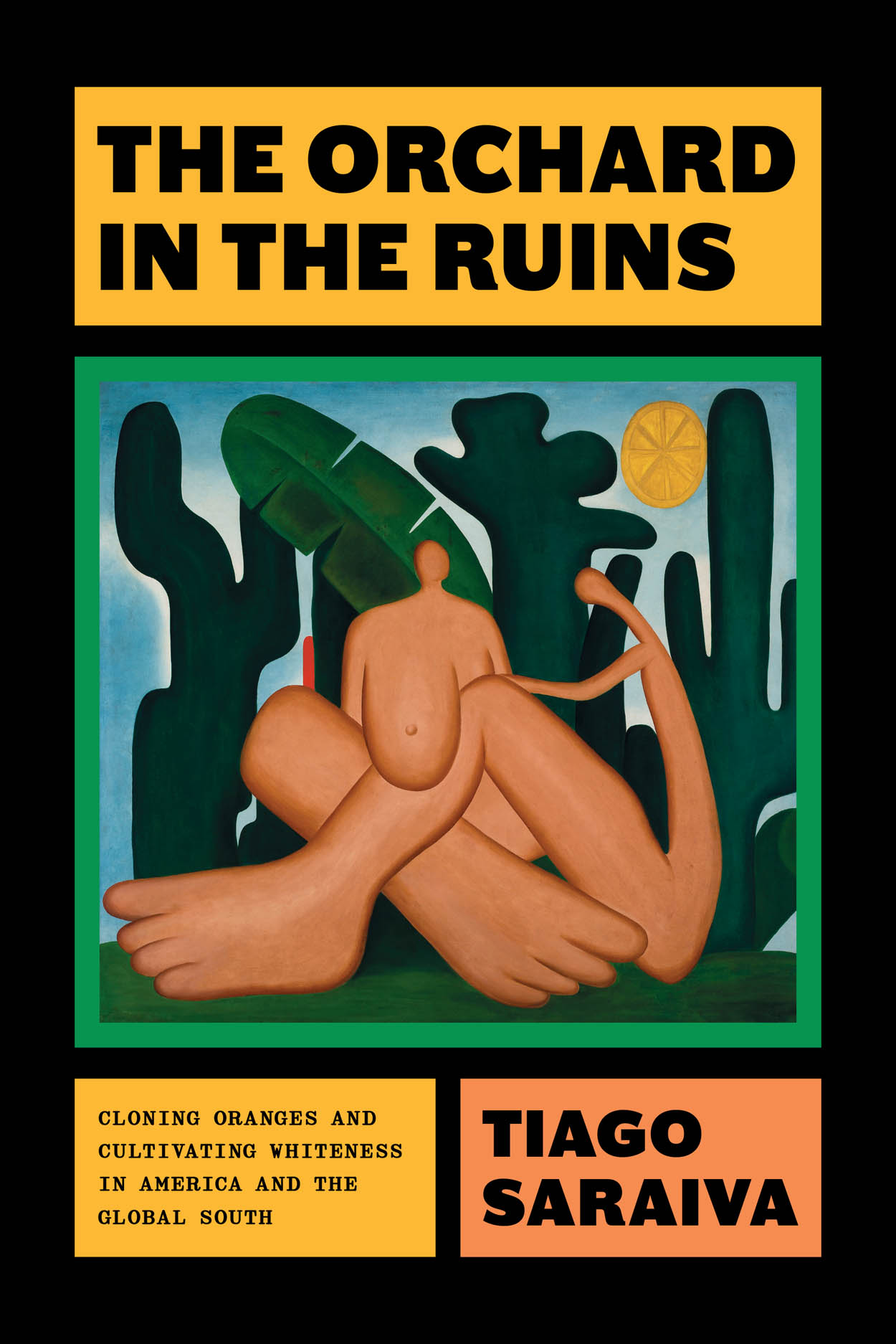
The Orchard in the Ruins
Cloning Oranges and Cultivating Whiteness in America and the Global South
The Orchard in the Ruins
Cloning Oranges and Cultivating Whiteness in America and the Global South
Ingeniously connects the history of citrus cultivation to the production and maintenance of whiteness in sites around the world.
In The Orchard in the Ruins, acclaimed historian Tiago Saraiva illuminates the global impact of cloning Californian oranges, a practice that emerged in the aftermath of the great depression of the 1890s. Cloning promised control, uniformity, and resistance to an array of environmental and economic threats. But Californian orchards—white-owned but tended by workers of Chinese, Japanese, Mexican, or Indigenous origin—were also places where plantations and race intertwined. Agricultural anxieties about strains of oranges and their value, Saraiva shows, formed a continuum with anxieties about vanishing whiteness.
The Orchard in the Ruins connects Californian history to other sites of citrus cultivation: South Africa, where concerns about white poverty grew during the early twentieth century; Mandatory Palestine, where orchards were key to Zionist undertakings; colonial Algeria, where French settlers transformed the landscape with European farming techniques; and Brazil, where orchards were cultivated post-abolition. Drawing on local histories as well as the works of John Dewey, J. M. Coetzee, Edward Said, Frantz Fanon, and artist Tarsila do Amaral, Saraiva shows that in each place, orchards grew in the wake of specific historical crises. Orange cultivation was a transnational project in cultivating whiteness, one in which studies of fruits, buds, rootstocks, fungi, and viruses became race-making experiments.
A must-read for anyone interested in the history of science, technology, agriculture, and race, The Orchard in the Ruins reveals a troubled account of science-led attempts to remedy crumbling worlds.
240 pages | 12 halftones | 6 x 9 | © 2026
History: Environmental History, History of Ideas, History of Technology
Reviews

Table of Contents
Introduction: The Angel of History and the Plantationocene
1 Horticulture and the Reconstruction of American Democracy
2 Cloning Oranges and Whiteness in California
3 White Writing, Outspan Oranges, and “Going Native” in South Africa
4 Orientalism: Jaffa Oranges in Mandatory Palestine
5 The Wretched of the Earth: Rooting and Uprooting Algerians
6 Cannibalism and Sadness: Cloning California in São Paulo
Bahian Epilogue
Acknowledgments
Notes
Bibliography
Index