Distributed for Museum Tusculanum Press
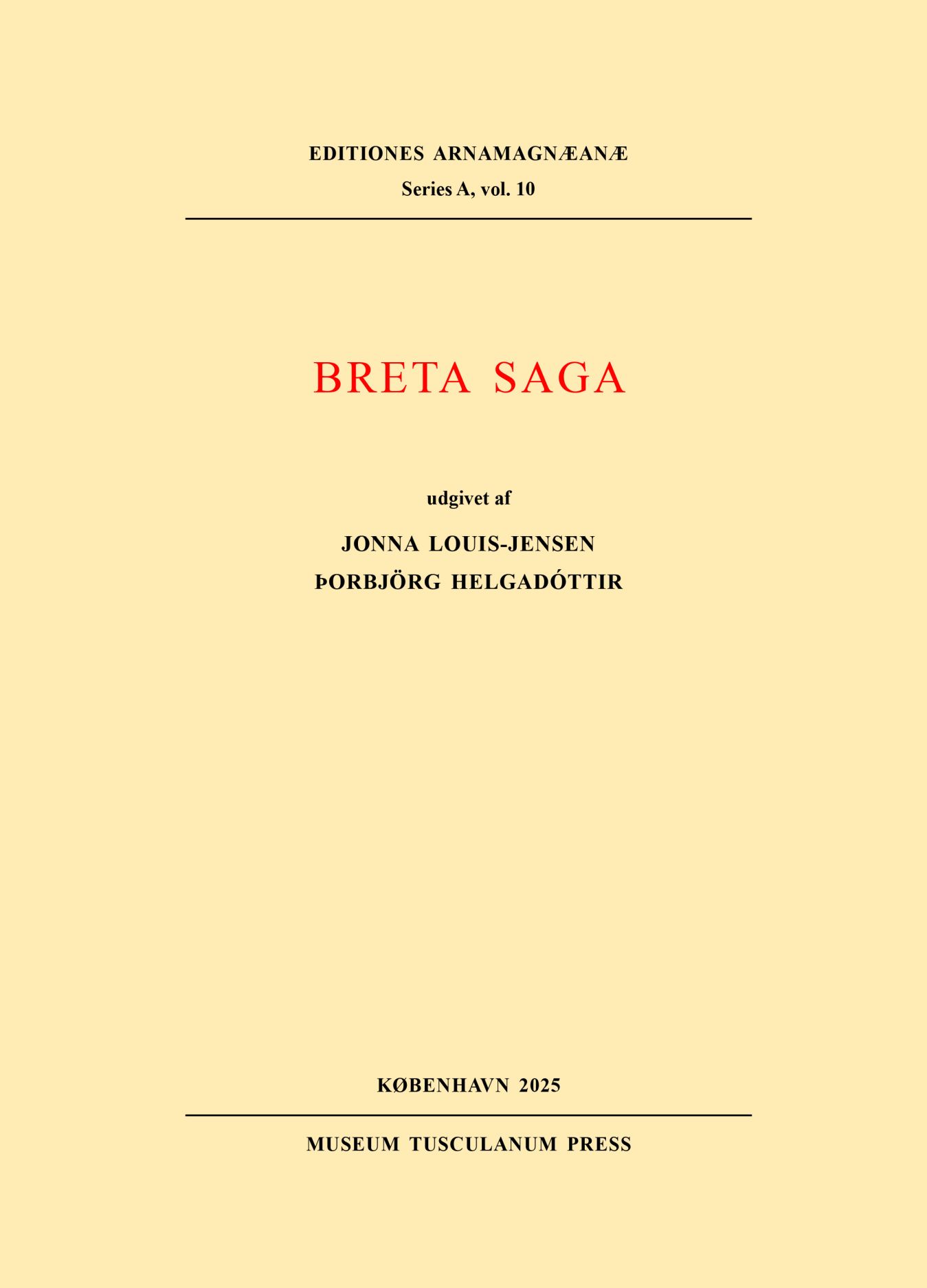
Breta Saga
A unique edition of the Breta saga that presents Old Norse translations of Geoffrey of Monmouth’s Historia regum Britanniae, offering a rare view of the legendary history of the kings of Britain across its multiple versions.
Between 1130 and 1138, probably in Oxford, Geoffrey of Monmouth (c. 1100–1154) wrote his major work on the British kings, Historia regum Britanniae, which quickly became very popular. As soon as the mid-twelfth century, the French poet Wace had translated and reworked this work into verse, a work known as the Roman de brut. It is assumed that Geoffrey’s entire work was translated in Iceland at the beginning of the thirteenth century, and in the Old Norse tradition, it was most often called Breta sögur. In this publication series, however, it has been given the title Breta saga. In the manuscripts, Breta saga is conceived as a continuation of Trójumanna saga, an Old Norse translation of the story of the Trojan War, since the two texts always accompany each other. Breta saga is preserved in two versions, one longer and one shorter. The short version is closest to Geoffrey’s Latin text, whereas the text of the long version contains interpolations that point toward Wace’s French translation.
This edition of the Breta saga reproduces these four transmissions of the text. The texts are laid out in the same manner as in Jonna Louis-Jensen’s edition of Trójumanna saga, with the long version of the saga printed at the top of the page and the short version at the bottom. The introduction discusses the various parts of the saga, with a focus on the translation’s rendering of the Latin text and on the relationship between the two Old Norse versions.
220 pages | 2 color plates | 6.89 x 9.65 | © 2025
Editiones Arnamagnæanæ, Series A
History: European History
Literature and Literary Criticism: Germanic Languages


Table of Contents
Forord vii
INDLEDNING xi
1 Oversigt xiii
1.1 Håndskriftoverlevering xiii
1.2 Tidligere udgaver af Breta saga xvi
1.3 Den vigtigste forskning om Breta saga xvii
2 Gennemgang af de forskellige tekstdele, som udgør Breta saga xix
2.1 Begyndelsen af sagaen, Æneas-delen xix
2.1.1 Sammenligning af O¹ med citater i svenske leksikografiske værker fra det 17. århundrede samt tilsvarende tekststeder i S¹ og Hb xix
2.1.2 Tilføjelse i Hb sammenlignet med O¹ og S¹? xxvi
2.2 Oversættelsen af HRB fra kap. 6–79, hvor O¹ slutter xxviii
2.2.1 Sammenligning af O¹ med citater i de svenske leksikografiske værker fra det 17. århundrede samt tilsvarende tekststeder i S¹, Hb og HRB xxviii
2.2.2 Tekst fra Breta saga i håndskriftet AM 764 4to (764) sammenlignet med S¹ og O¹ lvii
2.3 Teksten i S¹ efter slutningen af O¹ sammenlignet med Hb og TCD, svarende til kap. 80–134 i HRB lx
2.3.1 Uorden i overleveringen i S¹ lx
2.3.2 Fælles tekstoverlevering i S¹, Ambrósíuss saga og Rímbegla lxi
2.4 Teksten på fol. 46r–63r i S², Arthur-delen, sammenlignet med Hb og kap. 135–78 i HRB lxiii
2.4.1 Indskud som må stamme fra et andet forlæg end HRB lxiii
2.4.2 Indskud fra oversætteren? lxx
2.5 Slutningen af Breta saga i Hb svarende til kap. 179–206 i HRB lxxi
2.5.1 Tegn på angelsaksisk indflydelse i Breta saga lxxi
2.5.2 Tekst fra Breta saga i håndskriftet AM 764 4to (764) sammenlignet med Hb lxxiv
2.6 Slutningen af Breta saga i Hb, som ikke svarer til slutningen i HRB kap. 207–08 lxxvi
3 Sammenfatning og konklusion lxxvii
4 Jonna Louis-Jensen: Om et håndskrift af Jónsbók med fragment af Breta saga i Trinity College Dublin lxxxi
4.1 Håndskriftet TCD MS 1023 lxxxi
4.2 Fragmentet TCD MS 1023 a lxxxiv
Denne udgave lxxxvii
Bibliografi lxxxix
Summary xciii
Navneregister til Indledningen xcv
Benyttede og citerede håndskrifter xcvii
Billeder af TCD MS 1023 a c
BRETA SAGA 1
Navneregister til tekst 198