Distributed for Omnidawn Publishing, Inc.

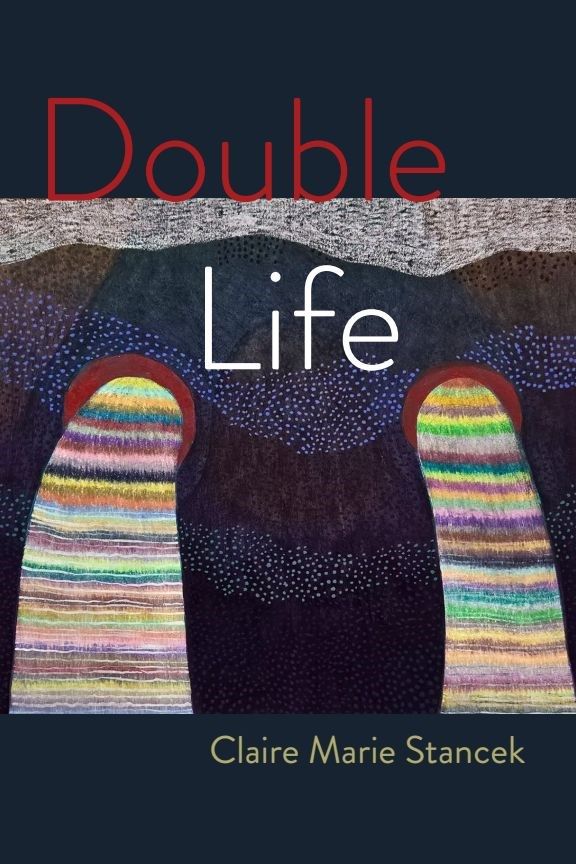
Double Life

Experimental poetry that explores doubling, selfhood, and interrelation.

At the heart of Double Life is the lived pressure of motherhood, with its cycles of interruption and return, and the competing urgency of thought and art. With this formally intricate collection, Claire Marie Stancek constructs a poetics of doubleness, employing structures of repetition and variation and working within a lineage of autobiographical experimentation (with a nod to Lyn Hejinian’s My Life). Stancek’s poems invite multiple modes of reading: across both columns and down each column independently. Meaning accrues through juxtaposition and drift, as phrases echo, refract, and recombine across the physical space of these poems. Parallel lives unfold in tandem, sometimes converging, sometimes diverging. 

These poems pay close attention to the textures of the everyday while allowing moments of sonic wonder and perceptual shimmer to break through. They ask what it means to “double” life outward from the self into relation, community, and an ever-widening field of attention. Reading Double Life we find how attention, in its most heightened form, might transform repetition into radiance.


98 pages | 6 x 9 | © 2027

Poetry

Religion: Judaism

Women's Studies


Omnidawn Publishing, Inc. image

View all books from Omnidawn Publishing, Inc.

Reviews

“The beautiful, frank, often intimate poems of this book ‘dissolve into caring.’ These are days. A SEPTA bus groans by. A child’s vomit triply smells while a cat deigns to frown at the proceedings. Domestic archives re-discovered include discharge documents from the NICU, while starlings outside hop about as if mocking with their freedom, and the pages the poems are written on boast spit-up stains as apt interruptions. Whereas ‘today, all I wish is / To follow a train of associations,’ this is no minimal hope, for Stancek’s poems, following the late Lyn Hejinian in this among other respects, consist of interconnection and free flow. I can think of no better poetics than what’s exactly here, describing the double life as it is actually lived.”

Al Filreis, Kelly Writers House, University of Pennsylvania

“In Stancek’s Double Life a mother-poet narrator, chronicler of the domestic, writes the usually derided and excluded into a stellar orchestra of daily life where ‘A thought / rushes faster than the music.’ Tightly bound and exploding within the structure of 36 poems, each in 36 sections, written in her 36th year, Stancek immerses us in four sections, seasons, in which when writing comes, ‘it’s as though life / doubles upon itself, life / richer than life. multiplying.’ In an acrobatic feat of composition, sentences broken into two columns by a jagged space between, punctuated by // slashes—read vertically, horizontally, left to right or vice-versa—all yield stunning thought-music. Litanies of objects and events: the breast pump, theory, children’s rhymes, demands, vomit, scarring flesh, expensive writing time, search for a lost sock, distant and lost friends, internal, overheard and spoken dialogue, punctuated repeatedly by the cat, suddenly the flowers, animals and foliage of the seasons—are shot through with the dazzlingly ‘Alive.’ These returning recitations sound shadow lists that startle in mishearings and surface a latent violence: the children in one reading become what’s given away in another. Be multiplied, divided, recast, by this stunt double, secret-keeper and breaker, aka mother who gives us necessary, courageous and beautiful writing of the unwritten. ”

Susan Gevirtz author of "THRALL"

“The very concept of two collides interweaves overlaps kaleidoscopically in this mindblowing writing that one is required to do here. Stancek has us both ways: at a loss for mastery, and in the brilliant writer’s seat of word clusters of our own designs. The experience is kinetic, loose-ended, addictive, ultraconscious and smart. Lyn Hejinian’s My Life cracks open, producing Double Life in the twenty-twenties. Are we the babies of this book or its mothers? Answer through the wombwork, swimming and lifeguarding in the plural present, differently at each stunning split second of our fluid, messy, luminous lives. Thank you Claire Marie Stancek!”

Sarah Riggs, author of "Lines"

Be the first to know

Get the latest updates on new releases, special offers, and media highlights when you subscribe to our email lists!

Sign up here for updates about the Press