Distributed for Omnidawn Publishing, Inc.
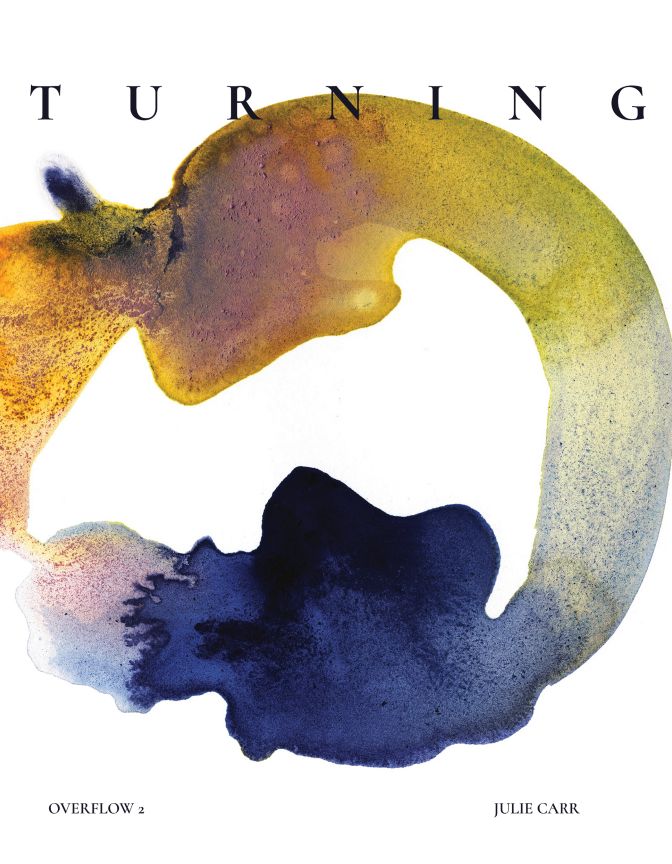
Turning
Grounded in the Jewish practice of teshuva, this collection of poetry and prose considers the motions of turning inward and toward one another amid trauma and genocide.
The second book in Julie Carr’s Overflow trilogy, Turning takes its foundation from the Jewish practice of “teshuva,” a Hebrew word that means “to turn” or “return,” though it is usually translated as atonement. This turning towards oneself generates a turning toward the other, recognizing one’s obligations and asking for pardon.
Carr began writing Turning during a year of crisis, when, during 2022 and 2023, there were three shootings at her daughter’s school. Two young people died, three people were severely injured, and the entire community experienced a grim and exceedingly common trauma. Amid this period, further tragedies unfolded with Hamas’s attack on Israel and Israel’s subsequent bombing and starving campaign against Palestinians. In this bitter genocide, Carr finds that the practice of teshuva becomes an ever more urgent imperative for Jewish people and communities everywhere. In the act of turning lies a powerful and radical longing for justice and for love, without which no peace is possible.
Turning employs three primary forms. Long lines justified left turn into shorter lines, justified right, deliberately disorienting the eye and mind of the reader. List poems catalogue the many things that, in ways, turn, from electrons to orbiting moons. Finally, blocks of prose explore a sequence of turning narratives, some of which carry dream-like surreal twists. Throughout, a violent context presses against characters, including the “I,” as they try and sometimes fail to turn toward each other for friendship, forgiveness, and accountability.