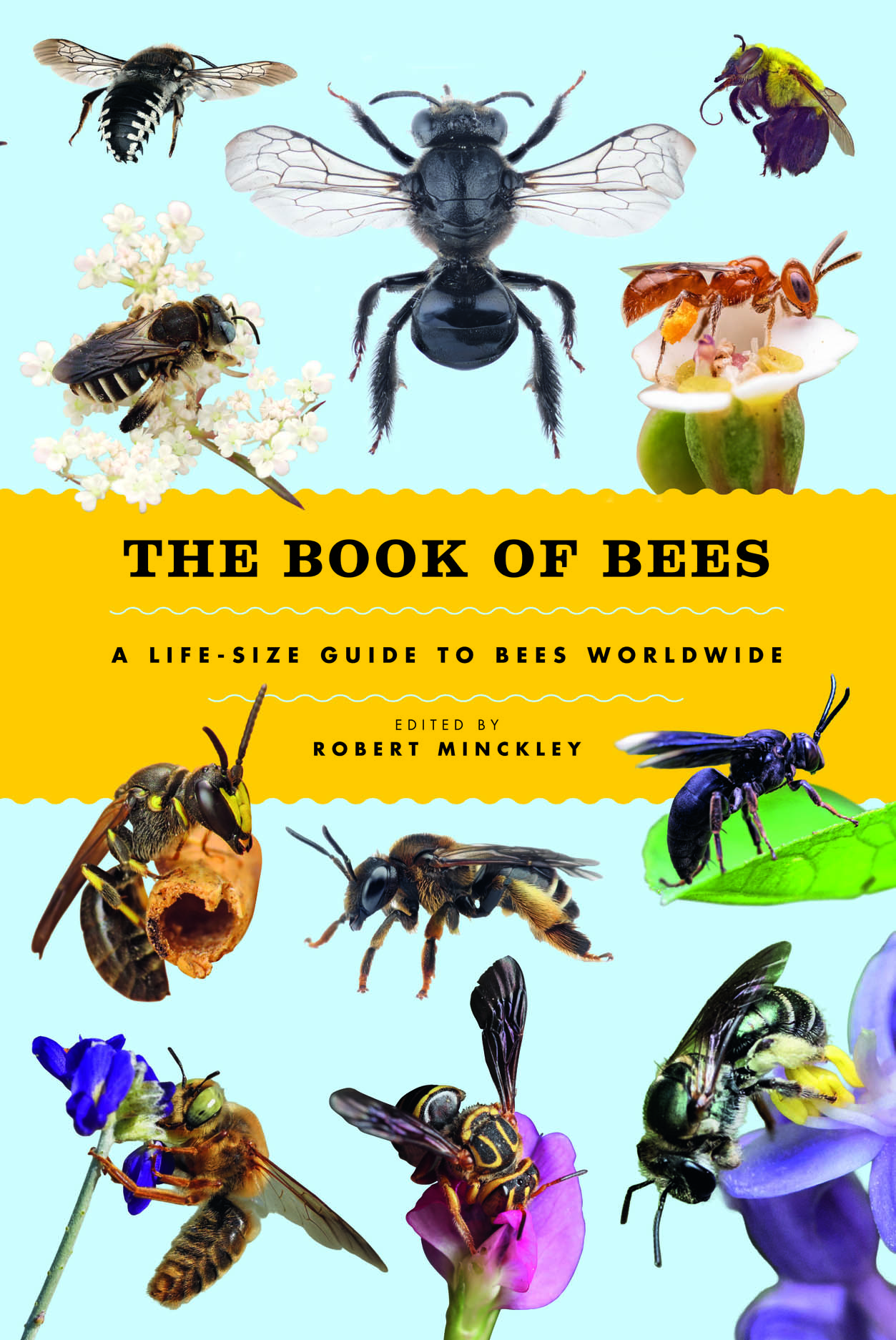
The Book of Bees
A Life-Size Guide to Bees Worldwide
The Book of Bees
A Life-Size Guide to Bees Worldwide
Including more than four hundred species from all seven recognized biological families, a beautiful visual celebration of bee species the world over.
The honeycombs, hives, dancing, and royalty of bee colonies have long captured the public’s imagination, but there’s far more to these insects. There are over 20,000 bee species, but only a handful have colonies approaching the organization of the familiar western honeybee. The typical bee, if there is one, is solitary. It nests in the ground or a stem and has seven to fifteen offspring that develop and emerge the following year, long after their mother has died. These solitary species vary tremendously in the flowers they visit, how they collect pollen and nectar, the architecture of their nests, and how males strategize to find mates. Furthermore, another 17% of all bee species are well-armored parasites, often with striking colors and an array of tactics for attacking other bees.
Bees’ keystone contribution, as pollinators, to the human food supply and to the proper function of ecosystems far exceeds their numbers. From the emerald-green dilemma orchid bee to the spined leafcutter cuckoo, The Book of Bees celebrates bee species worldwide, highlighting a broad range of their diversity to illustrate how different they are in behavior, life history, and interactions with flowers and humans. Each entry includes a distribution map, a table of essential information, a section on related species, and a description of the species’ importance in terms of taxonomy, rarity, behavior, and scientific significance. Striking photos show the bees at their actual size and are also enlarged to showcase intricate details.
This wide-ranging exploration of social, solitary, and parasitic bees offers fascinating insights into their remarkable lives, fostering greater appreciation of their ecological importance and the need for their conservation.
512 pages | 7 x 10 | © 2026
Life-Size Guides to the Best of Nature
Biological Sciences: Biology--Systematics, Natural History
Guides, Manuals, and Reference:

Table of Contents
Introduction
Bees or wasps?
Classification
Morphology
Social organization
Parasites
Bee evolution
Bee diversity and distribution
Bees and plants
The life cycle of bees
Nests: Designs and where to build
Male bees
Natural enemies
Bees and agriculture
Bee conservation
The bees
Melittidae
Megachilidae
Apidae
Halictidae
Stenotritidae
Colletidae
Andrenidae
Appendices
Glossary
Further reading
Classification of bees
Index
Picture credits
Acknowledgments